Hunter Valley's Leading Residential & Commercial Solar Installers

Hunter Valley's Leading Residential & Commercial Solar Installers
Posted 15 Nov
Want the latest in energy, solar, and savings?Subscribe to our newsletter – we don’t spam!
Updated October 2026
Heating water with a conventional element and storage tank takes a lot of energy, and in most Australian homes it is one of the biggest electricity uses all year round. You have three ways to cut the cost: heat the water when your solar is producing, switch to a heat pump, or do both.
This guide covers how much power a hot water system uses, how controlled load works today, and what a heat pump could save you.
Why Heating Water Takes So Much Energy
Water soaks up a lot of heat. Heating 100 litres of water from 15°C to
60°C takes about 5.2 kWh of energy, and that is before any heat is lost along the way. A storage tank also has to hold its water at
60°C or higher around the clock to stop bacteria such as Legionella growing.
Hot Water Is About a Fifth of Your Energy Use
Heating water accounts for about 20% of the average household's energy use, according to Energy Made Easy, the Australian Government's
energy comparison service. That makes it one of the best places to look for savings.
Household size and habits. Long showers, hot water washes and a high flow showerhead all add up.
Tank temperature. Energy Made Easy suggests a thermostat setting between 60°C and 65°C. Do not turn it below
60°C, because that is the temperature that keeps Legionella in check.
When you heat. Controlled load, your general rate and your own solar all cost different amounts.
The type of system. An electric element and a heat pump use very different amounts of power for the same hot
water.
An electric storage system heats water with an element, so every kilowatt hour (kWh) of electricity becomes about one kWh of heat. A heat pump moves heat from the air into the water instead, so it can deliver three to four kWh of heat for every kWh of electricity it uses. The ACT Government's buyers guide estimates that heating a 300 litre tank to 60°C takes about 14 kWh a day with an electric element and about 4.7 kWh a day with a heat pump, roughly two thirds less.
| System (300 Litre Tank) | Energy per day |
Energy per year |
Example cost at 30c/kWh |
| Electric element | about 14 kWh | about 5,110 kWh | about $1,533 |
| Heat pump | about 4.7 kWh | about 1,715 kWh | about $515 |
These are estimates. Your numbers depend on household size, tank size, climate and the rate you pay, so multiply the kWh by the rate on your
bill. If you are on a cheaper controlled load rate, the gap will be smaller.
A controlled load is a separate circuit for your hot water system. Your electricity network switches it on at set times, and in return the electricity costs less than your general rate. The controlled load rate is shown on your bill and varies by retailer.
There are two common types. In Ausgrid's network area, which covers most of Newcastle and the Hunter:
The old rule that controlled load 1 runs from about 11pm to 7am no longer holds for everyone. In July 2024 Ausgrid changed the controlled load 1 switching times for customers with a smart meter, so tanks can also heat during the day using solar. Ask your retailer or check your bill for your own times.

Look at your electricity bill for a separate line called controlled load, sometimes numbered 1 or 2. Your hot water system will also be on its own circuit at the switchboard, and an electrician can confirm this for you.
Your solar system connects to your general supply, but a controlled load hot water system sits on its own separate circuit. That usually means your solar cannot heat the tank directly, which is why many solar households use a timer or a solar diverter instead.

For years, solar households were better off exporting during the day and heating their water at the cheaper night rate. That has flipped. Export payments are now well below what you pay to buy electricity, so a kWh of solar used at home is worth more than a kWh sent to the grid. Using solar to heat your water during the day is often a better deal than relying on the controlled load.
Midday is when many solar homes are exporting at the same time, which is one reason export payments are lowest then. As a simple example, if you are paid 5 cents per kWh for exports and pay 30 cents per kWh to buy electricity, using a kWh at home instead of exporting it is worth 25 cents more. Hot water is a good way to use that midday solar, because a tank can store the energy until you need it.
The next approach is to use a hardware device called a solar diverter. There are many kinds of this device on the market but all attempt to monitor the solar generation situation and make intelligent decisions as to when to switch the hot water element on and when not. Some detect export power flowing into the grid above a value represented by the power rating of the hot water tank element.
Others monitor grid voltage and when it rises to a high value that signals to inhibit inverter export it switches the element on.
In all cases of course the element is in series with the tank thermostat and if the thermostat signals that the water has reached the upper set point no further heating occurs.
Therefore, there is a solution to declining export tariffs by maximising a household’s self consumption. Of course any method involves modifications to the house wiring, work that must be done by a licensed electrician. However it is small scale work and the diverters are affordable. How quickly the cost is recovered depends on your solar, your tariff and how much hot water you use.
| Option |
How it works |
Suits |
Watch out for |
| Time switch |
Turns the element on in the middle of the day | Solar homes that want a simple fix |
A cloudy day means some energy comes from the grid |
| Solar diverter |
Watches your solar output and switches the element on when there is spare power | Solar homes with an electric element tank | Needs an electrician and works with the tank element |
| Heat pump | Moves heat from the air into the water, delivering three to four kWh of heat per kWh of electricity | Anyone replacing an old electric or gas system | Higher upfront cost than an element, and some noise |
Heat pump hot water systems typically achieve a coefficient of performance (CoP) of 3 to 4. That means they deliver three to four times as much heat as the electricity they use, which is why they cost so much less to run than an electric element.

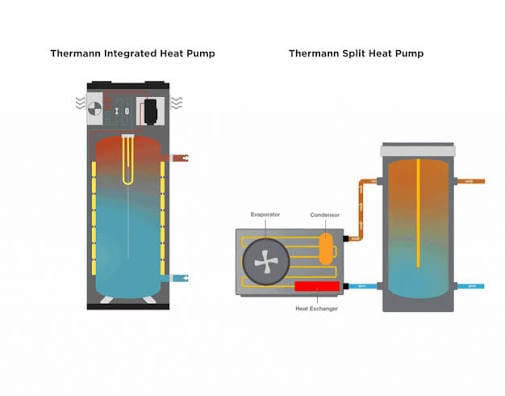
Image courtesy of Thermann hot water systems
Most home heat pump hot water systems come in two layouts. An integrated system has the heat pump sitting on top of the tank as one unit, usually outdoors. A split system has the tank separate from the heat pump unit, so the tank can sit indoors or in a different spot. Ask your installer which suits your space.

Two discounts can lower the price of a heat pump hot water system in NSW. Both are taken off your quote by the installer, so you do not apply for a rebate yourself.
NSW Hot Water Upgrade Incentive (Energy Savings Scheme): up to $640 when replacing an electric hot water system with a heat pump, or up to $330 when replacing a gas system. The heat pump needs a minimum 5 year warranty and must be installed by an accredited provider.
NSW Hot Water Upgrade Incentive (Energy Savings Scheme): up to $640 when replacing an electric hot water system with a heat pump, or up to $330 when replacing a gas system. The heat pump needs a minimum 5 year warranty and must be installed by an accredited provider. * Federal Small scale Renewable Energy Scheme: usually a few hundred dollars, and more than $600 in some areas, depending on your climate zone and the efficiency of the system. The value shrinks each year and the scheme ends in 2030, so installing sooner earns a bigger discount than waiting. Amounts and rules change, so confirm the current figures with your installer or the NSW Government before you buy.
What the Clean Energy Council's January to June 2026 report found on rooftop solar, home batteries, forecasts and complaints, and how to read the figures.
Read moreNot all batteries provide blackout backup by default. Learn what happens, what your battery is backing up, and how to stop your battery draining too fast.
Read moreFind available rebates & subsidies for solar systems, battery storage, and VPPs in NSW. Explore eligibility and maximise live incentives today.
Read more
Renewable News Articles
Sign up for new article updates - we don't spam.
We've invested in becoming fully-licensed and qualified installers to ensure homes and businesses get
the best solar, battery, and electrical systems available.
Certified solar system installers near you.
Get SAA-Approved Battery Installations.
Fully-licensed electricians Near You.
Convenient EV charging stations for properties.
Leave a Comment