Hunter Valley's Leading Residential & Commercial Solar Installers

Hunter Valley's Leading Residential & Commercial Solar Installers
Posted 24 Jun
Want the latest in energy, solar, and savings?Subscribe to our newsletter – we don’t spam!
Most Australian generally get their electricity bill and quickly glance at it as they flinch at their quarterly bill costs, however, the majority of homeowners don’t really understand what they’re looking at and why their energy bill is so high.
Buried inside every bill are the exact numbers that determine your overall energy costs, whether solar and battery is worth it, and how you can improve your energy bill and reduce your costs.
In this guide, we’re going to deconstruct a typical NSW electricity bill using a real bill from a Newcastle home and explain what each line means, what’s negotiable, and what you can do right now to help reduce what you’re paying.
Before we get into how to read your electricity bill, it helps to understand who is who on it and the difference between the companies that are involved every time you use electricity.
Your energy retailer is the company that issues your bill – Energy Australia, AGL, Origin Energy, Red Energy etc. These electricity retailers buy electricity from the wholesale market and sell it to you. These companies are the ones you call when there’s an issue with your bill or if you wish to change your plan.
Your electricity distributor/network provider (DNSP) is the company that owns and maintains the electrical grid poles and network infrastructure that deliver electricity to your property. In the Newcastle and Hunter region, Ausgrid is our electricity distributor. For regional NSW properties, it’s likely Essential Energy. These companies are dictated based on where you live and cannot be chosen by individuals.
The differentiation matters as a large portion of our energy bill are charges set by your distributor, not the retailer. Some costs set by the distributor are fixed and genuinely unavoidable but knowing the difference can help you understand what can and can’t be altered.
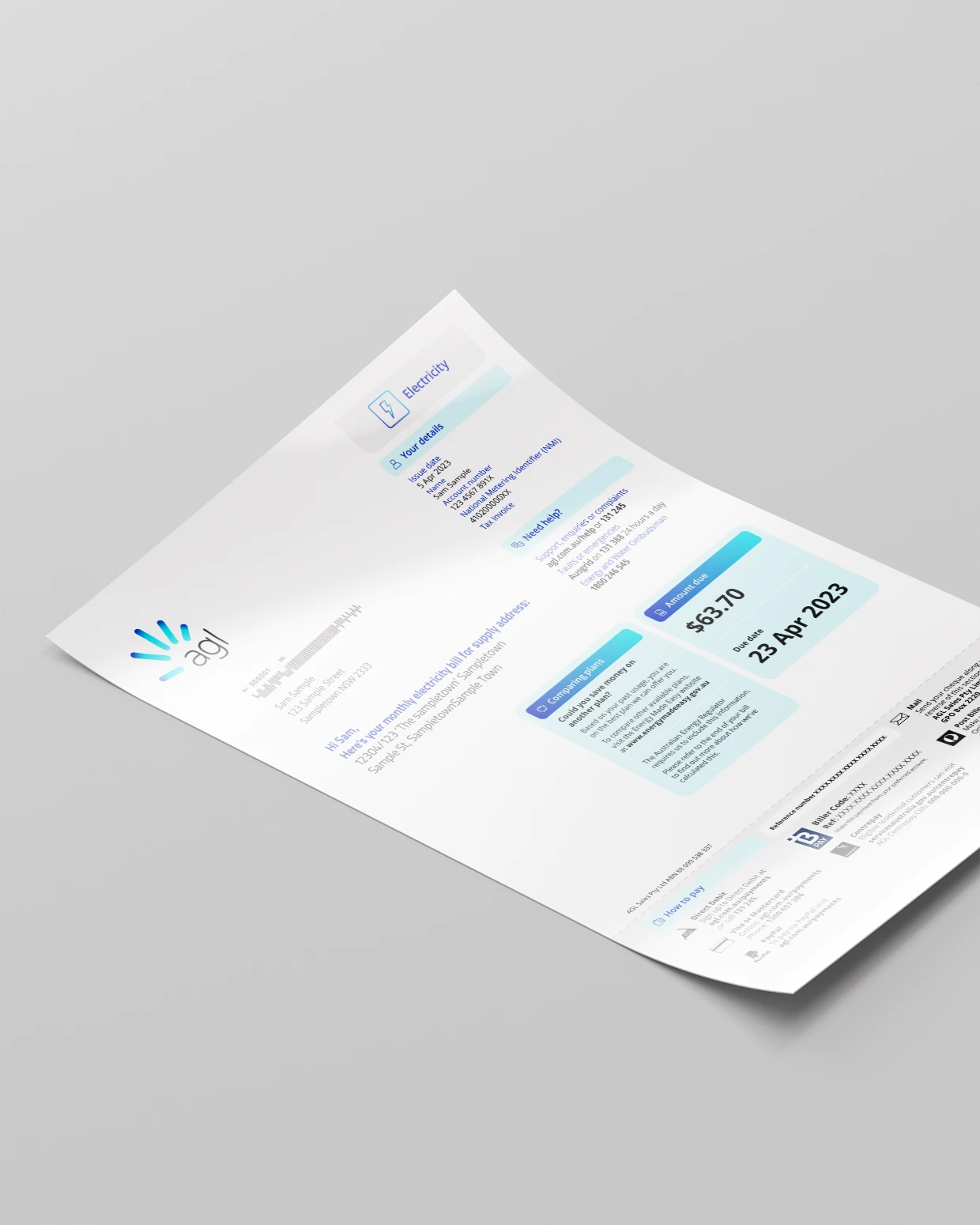
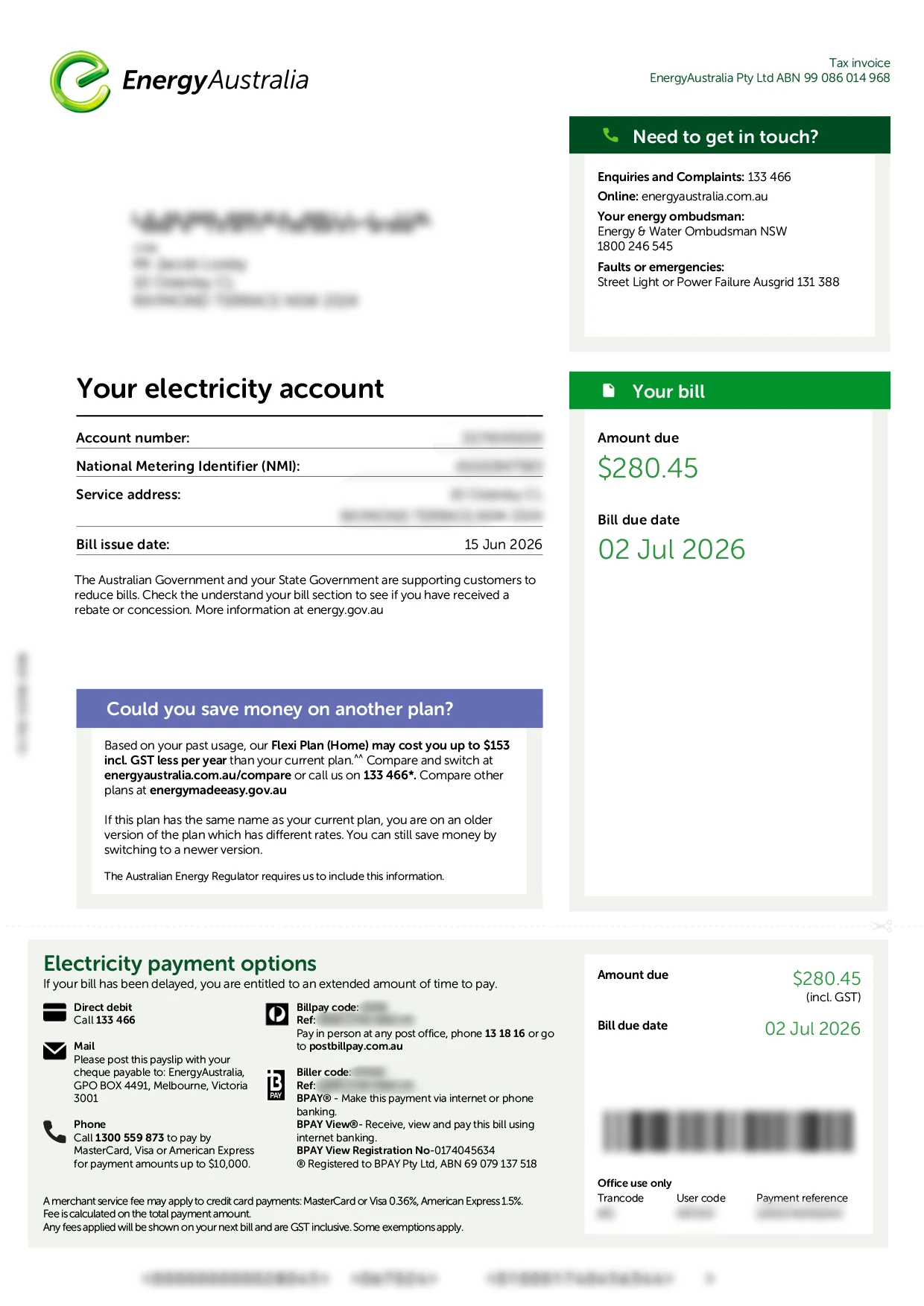
On the top of the first page, you’ll be met with your account details including account number, address, your National Meter Identifier (NMI), and the bill’s issue date. (Your NMI is a unique number that you refer to when switching retailers, getting solar installed, or accessing smart meter data).
Below the account details and billable amount, there will be a section which is required by law that outlines whether you’re on the best plan, based on your usage. The Australian Energy Regulator (AER) requires that energy retailers like Energy Australia show their customers if there’s a better plan available.
Using my energy bill as an example, Energy Australia tells me that I could save up to $153 per year on their Flexi Plan (Home) compared to the plan I’m on now.
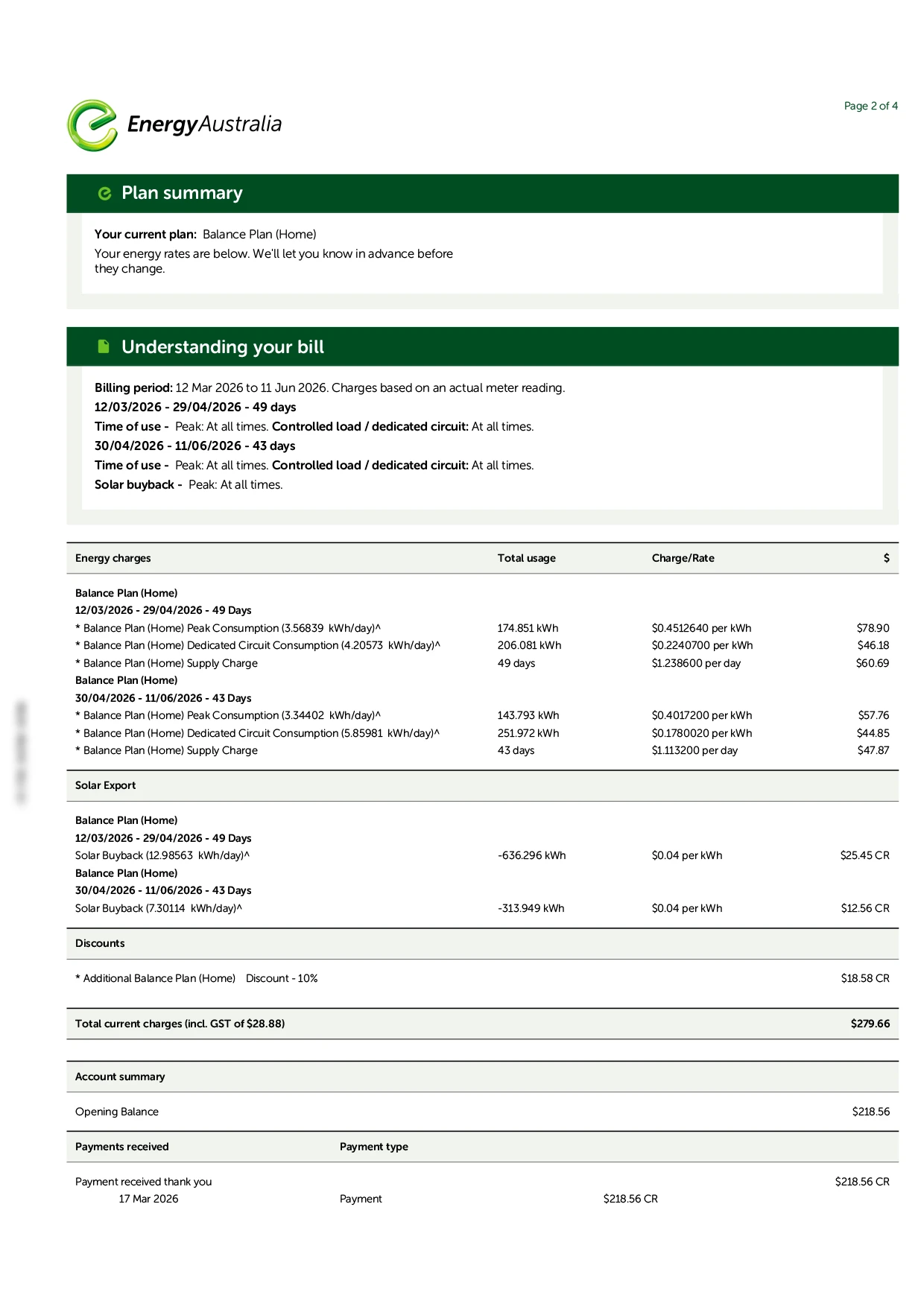
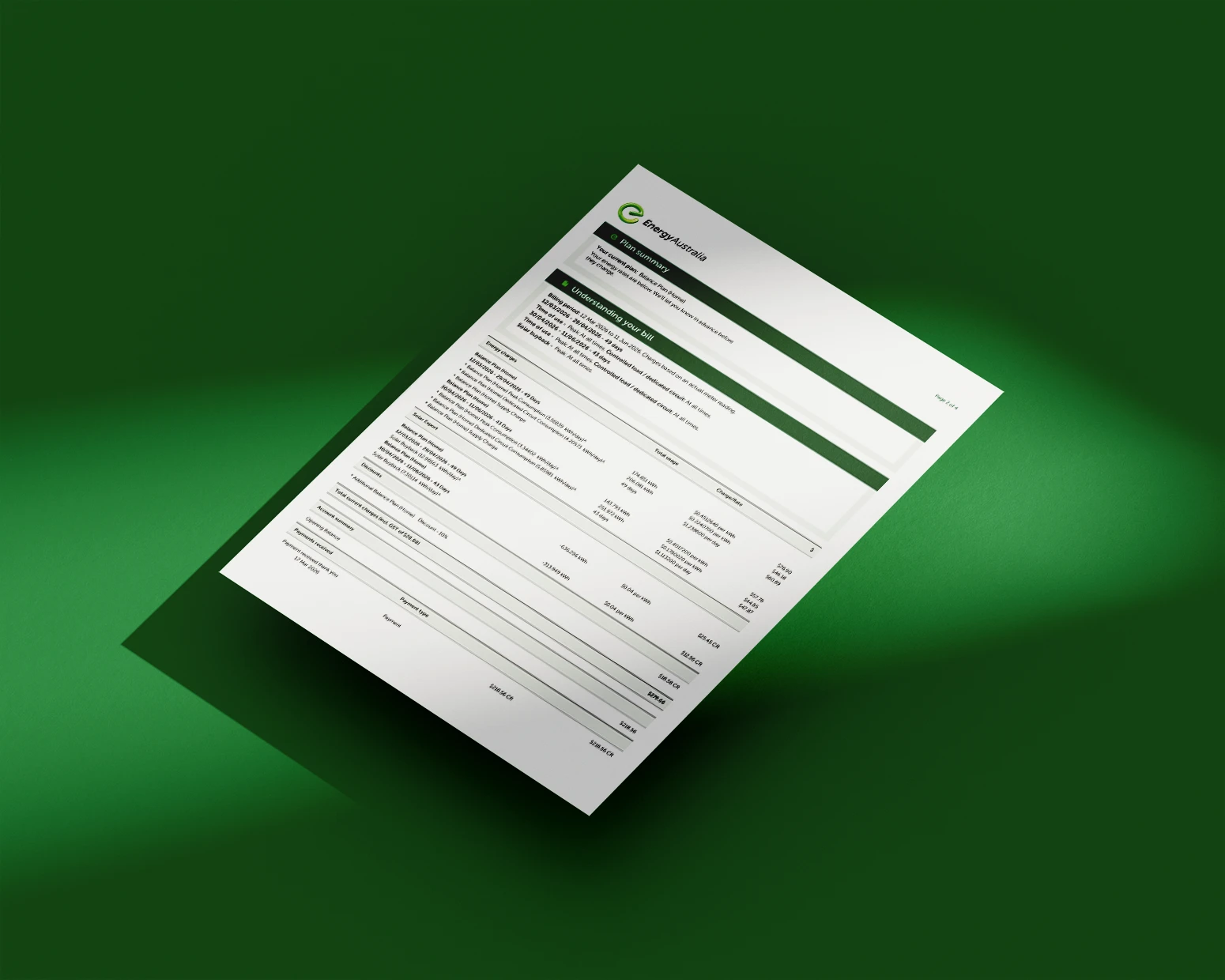
At the top of the next page, you get an overview of your plan summary, as well as a billing period breakdown of the tariff type you’re on.
Flat Rate vs. Time-of-use: Which Are You On?
A Time-of-use plan charges varying rates depending on the time of day. Breaking it down into peak, off-peak, and shoulder periods, the cost of electricity varies as demand increases during peak periods (5-9pm during winter).
| Peak |
2-8pm Weekdays (summer), 5-9pm (winter) |
50-70c/kWh |
| Shoulder |
7am-2pm & 8-10pm weekdays, 7am-10pm weekends |
25-35c/kWh |
| Off-peak |
10pm-7am daily |
18-25c/kWh |
The bill used in this example is on a flat rate tariff, which means there's only one usage line (however there are 2 different
periods). If you're on a time-of-use plan, you'll see separate line items for peak and shoulder periods.
A controlled/dedicated load is for a specific stand-alone load or appliance like an electric hot water heater or pool pump. They’re designed to power systems that can be powered during periods where grid electricity is at its cheapest.
(Rates are indicative for the Ausgrid network in mid-2026. Your exact periods and rates will vary by retailer and plan.)
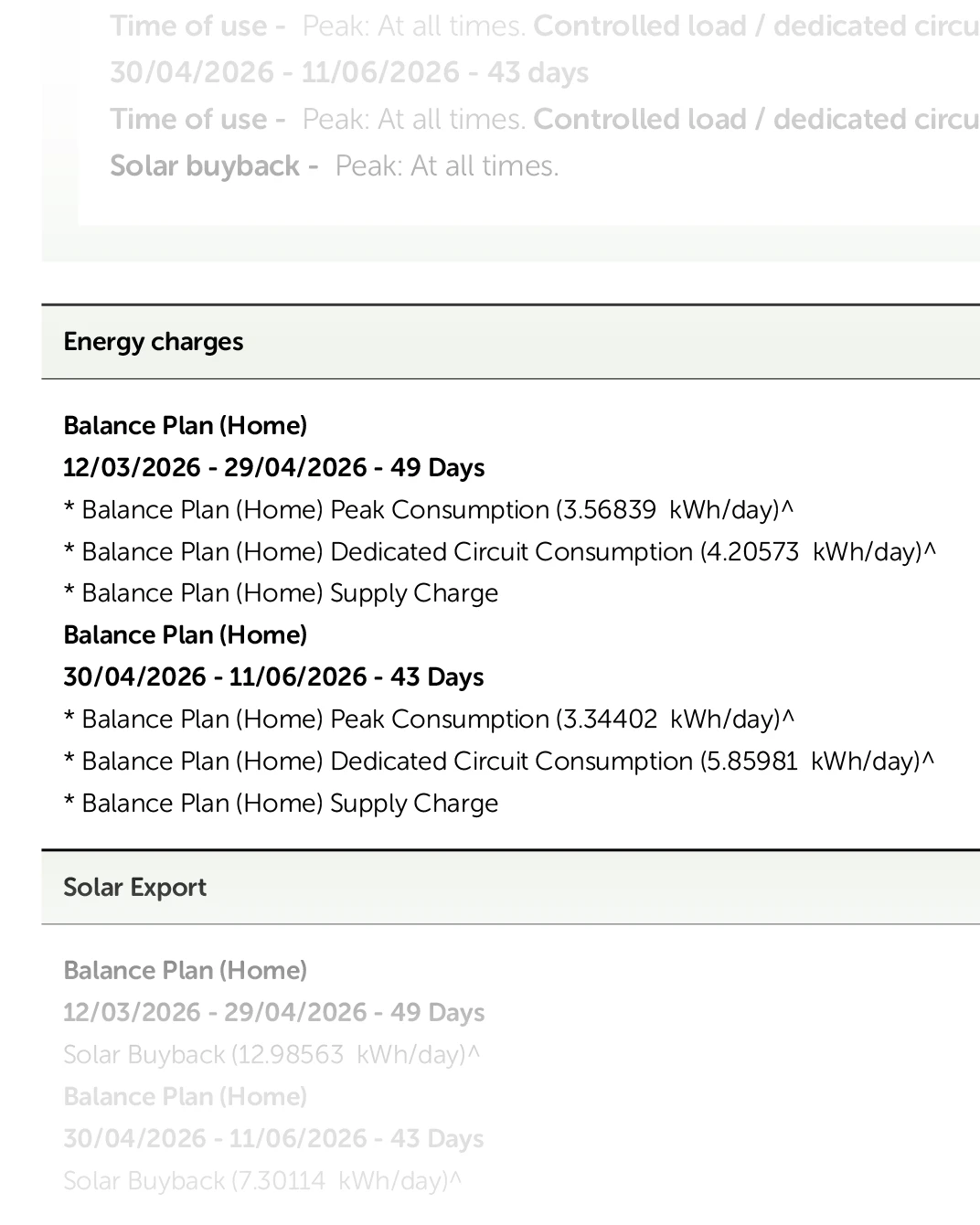
One of the most misunderstood elements to an electricity bill is the daily supply charge. Whether you use any electricity or not, the daily supply charge is essentially a fixed fee for being connected to the grid.
Designed to cover the expenses of maintaining grid elements like electricity poles and transformers, the daily supply charge helps support the infrastructure that keeps your home powered by the grid.
In NSW, the standard daily supply charge sits around $1.00–$1.10 per day. That's roughly $365–$400 per year before you've used a single kilowatt-hour. On this bill, the daily supply charge made up nearly 40% of the total bill - a figure most people don't realise until they look closely.
It's also going up. A recent communication from EnergyAustralia notified customers that their daily supply charge is increasing from $1.10 to $1.70 per day — an increase of over $200 per year on the supply charge alone.
Even for households with perfectly sized solar and battery system that covers all consumption, a daily supply charge means that your bill will never be $0. However, Amber customers have been able to recoup their costs by discharging their batteries during peak periods.
If your bill has a separate line on your energy bill for Controlled Load 1 or Controlled Load 2 (or CL1/CL2), this relates to the dedicated circuit for high-consumption appliances, mostly used for electric hot water systems or pool pumps.
Having a dedicated circuit enables the appliances to only be powered during off-peak periods when demand throughout the grid is at its lowest – usually around 10pm-7am. Because of this, the prices are reduced and come in at around 17-20c/kWh – less than half what peak pricing costs. (Energy Australia’s controlled load prices).
A few things to check:
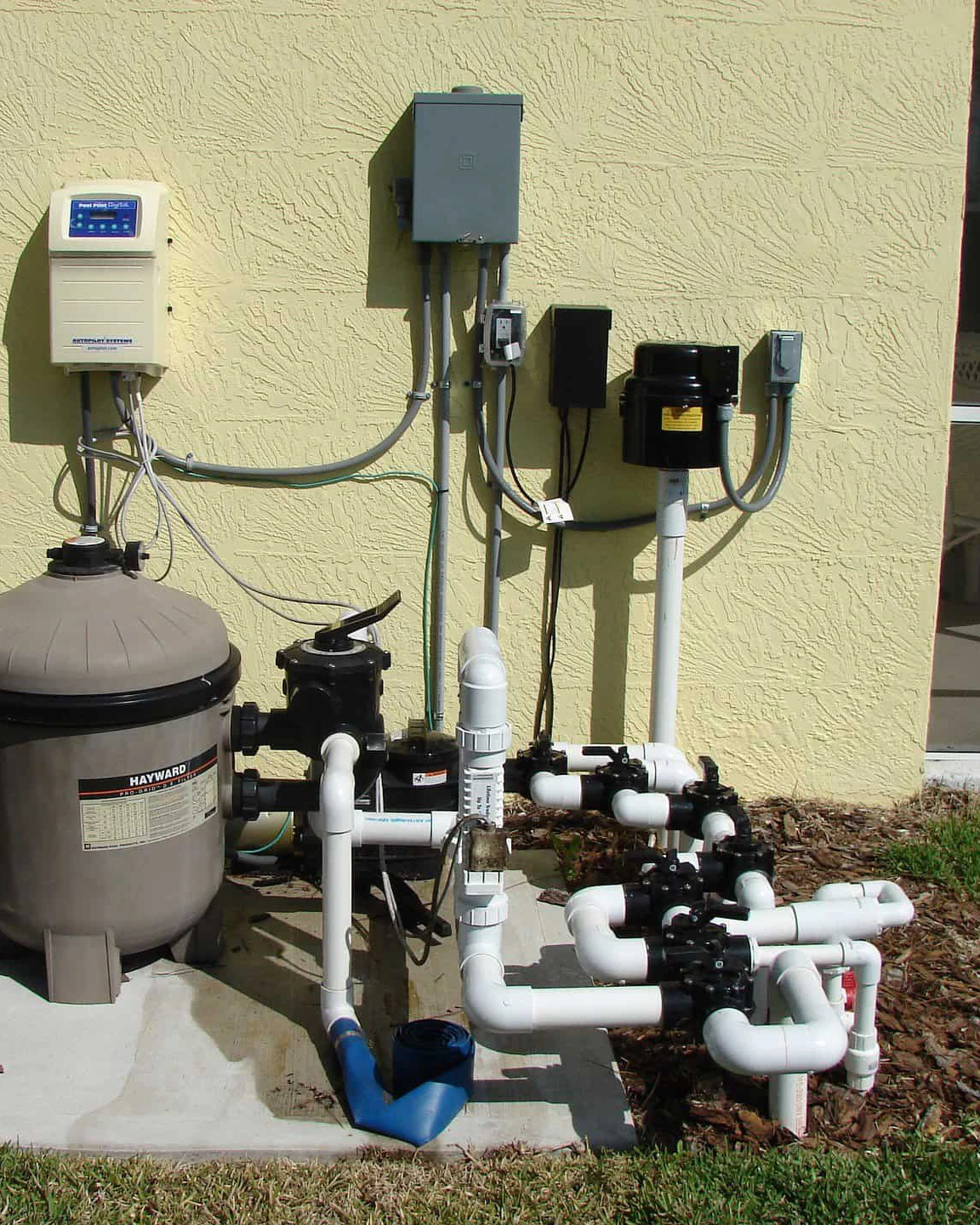
Image courtesy of Zenith Pools AZ - pool pump installation
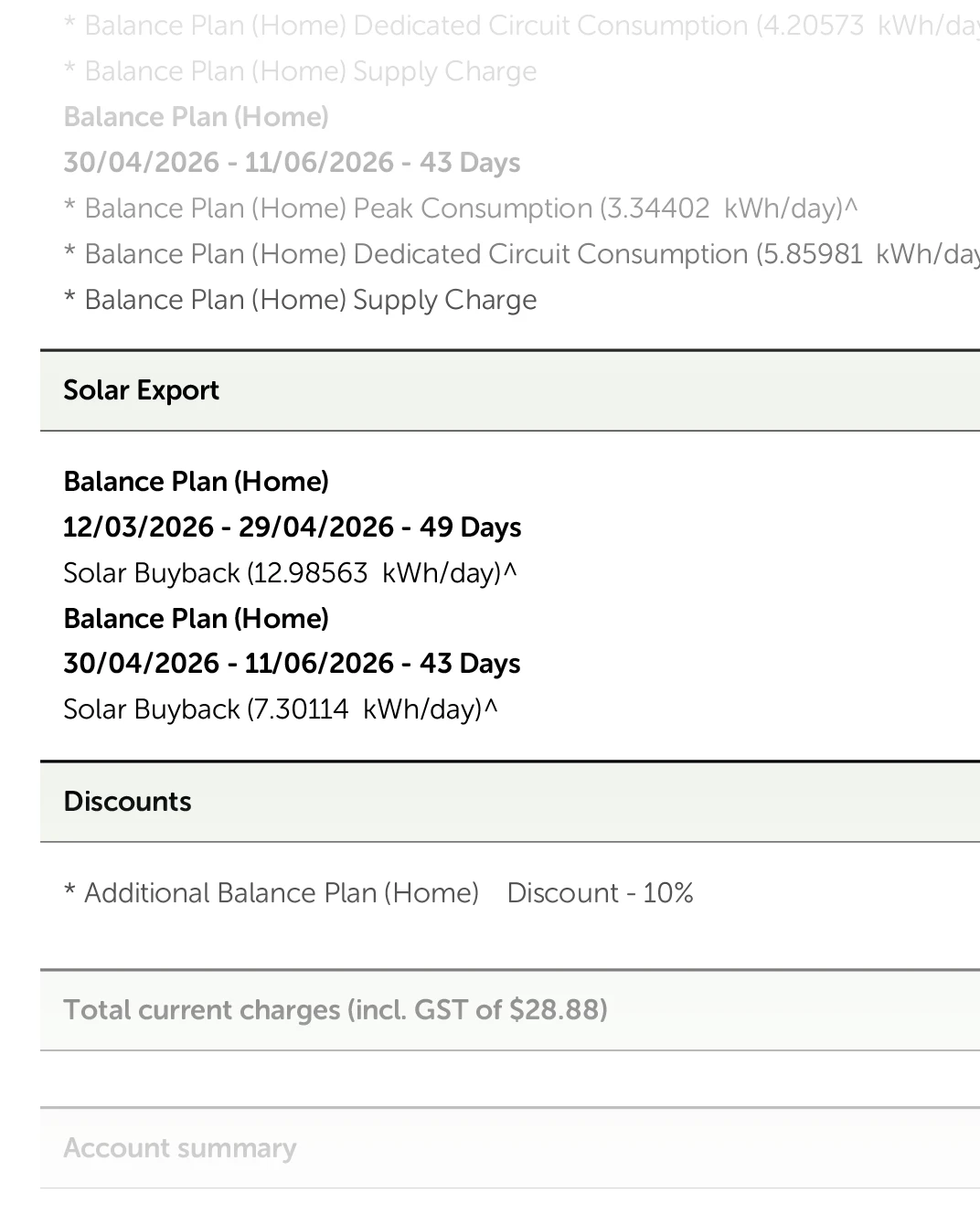
If you have solar panels, the solar feed-in tariff (FiT) or buyback section refers to how much excess solar energy you export into the grid, and how much you credit you earned for it.
You'll be able to see the total kWh exported, the rate per kWh your retailer is paying, and the credit amount applied to your bill.
What are NSW solar feed-in tariffs paying?
For NSW properties in 2026, most major retailers off between 3-10 cents for every kWh exported of solar. According to IPART, solar generation is currently worth between 3.4-6.5c/kWh until June 2027, however NSW retailers aren’t required to stay within these guidelines.
Some retailers offer higher rates, but with conditions:
It's also worth noting that Energy Australia is cutting their NSW flat rate FiT from 4c to 3c/kWh from 1 July 2026.
Most solar owners won't think about it until they see it written down, but if you're buying electricity at 30c/kWh during peak hours and only earning 5c/kWh when you export, every kWh you send to the grid is worth 6-times less than a self-consumed kWh.
Self-consumption is where the majority of your savings will come from. Actually using your solar energy rather than exporting is where most homes will find the most value - particularly when paired with solar battery storage. Energy storage has become attractive as it enables homes to store their excess solar power from the day, and delivers that power when the grid is at its peak.
Are you better off exporting excess solar or storing it in a battery? We strongly recommend considering a battery if you’re wanting to maximise your solar energy as it enables you to avoid the expensive peak energy prices.
Once you understand what each charge means, here's what you can do with it:
Check whether your 'better offer' section identified possible savings. As mentioned before, retailers are legally required to let you know when they can offer a better deal. If yours did, take a few minutes to compare your electricity plan.
Identify when you use most of your electricity. If the majority of your consumption falls in the peak periods, load shifting will provide the quickest win. Moving your dishwasher or washing maching to cheaper periods.
Compare supply charges between retailers. The daiy supply charge varies between retailers and is often overlooked when switching plans. Keep an eye out for slightly higher usage rate but significantly lower supply charge could provide more savings.
Review your controlled load rate. Confirm appliances like pool pumps and hot water systems are on a controlled tariff, and if you have solar, consider switching your appliance usage to when solar is producing.
Check your solar FiT rate. Retailer solar FiTs will vary, and if you're exporting a significant amount of energy, consider installing a battery to maximise it.
Electricity Bill Item
|
What is it?
|
Can you Change It?
|
| Daily Supply Charge |
Fixed cost to stay connected to the grid |
You can compare retailers for lower rates |
| Peak Consumption |
When you use energy during a peak period |
Yes, you can shift your usage to a non-peak period |
| Shoulder Consumption |
When you use electricity between peak and off-peak periods |
Yes, you can change the time you use energy to an off-peak period |
| Off-Peak Consumption |
When energy is consumed during an off-peak period – when energy is cheapest |
Yes, however, this is already the lowest rate |
| Controlled Load (CL1/2) |
A discounted rate dedicated for appliances that can be timed accordingly |
Yes |
| Solar Feed-in Tariff (FiT) |
Credit your accumulate for exporting excess solar to the grid |
Yes, you can compare retailer FiTs |
| Environmental Levy |
Government scheme contribution |
No, it is built into your usage rate |
| Concessions/Discounts |
Government rebates for eligible customers |
Apply if eligible, contact your retailer |
Your electricity could be much more than just another expensive bill you dread each quarter. Instead, it could be an indicator to help you maximise the way you use your electricity. By understanding what each section and term means in an electricity bill, you’ll be able to optimise and improve, and help reduce your overall energy bill costs.
Not all batteries provide blackout backup by default. Learn what happens, what your battery is backing up, and how to stop your battery draining too fast.
Read moreFind available rebates & subsidies for solar systems, battery storage, and VPPs in NSW. Explore eligibility and maximise live incentives today.
Read moreNot sure which battery matches your solar system? Compare solar & battery size combinations, from 6.6kW to 13.3kW+, & find the right fit in Newcastle.
Read moreThis article was written and published by the team at Elite Power Group, an SAA-accredited and fully-licensed solar and electrical company based in Newcastle, NSW. We've been designing and installing solar, battery, and EV charging systems across the Hunter region for years, and we read a lot of electricity bills.
Renewable News Articles
Sign up for new article updates - we don't spam.
We've invested in becoming fully-licensed and qualified installers to ensure Newcastle homes and businesses
get the best solar, battery, and electrical systems available. We want to assist Newcastle's renewable energy revolution with quality
installations for maximum customer satisfaction.
Certified solar system installers near you.
Get CEC-Approved Battery Installations.
Fully-licensed electricians in Newcastle.
Convenient EV charging stations for properties.
Leave a Comment