Newcastle's Leading Residential & Commercial Solar Installers

Newcastle's Leading Residential & Commercial Solar Installers
Posted 26 Nov
Want the latest in energy, solar, and savings?Subscribe to our newsletter – we don’t spam!
Looking into solar battery storage is already hard enough with numerous battery brands and models to choose from. However, it’s important to understand additional factors that define battery models like the difference between nominal and usable capacity vs. power output.
Quick answer: Energy capacity (kWh) is how much energy your battery stores. Power output (kW) is how fast it can deliver that energy. Both appear on every battery spec sheet and both matter, but they answer different questions. Capacity tells you how long the battery will last. Power output tells you what it can run at once.
Energy capacity is the total amount of energy a battery can hold, measured in kilowatt-hours (kWh). It is the number that determines how long your battery can supply power before it needs recharging.
Think of it like a water tank. The size of the tank tells you how much water is available in total. A larger tank means more stored energy and longer runtime before the battery is depleted.
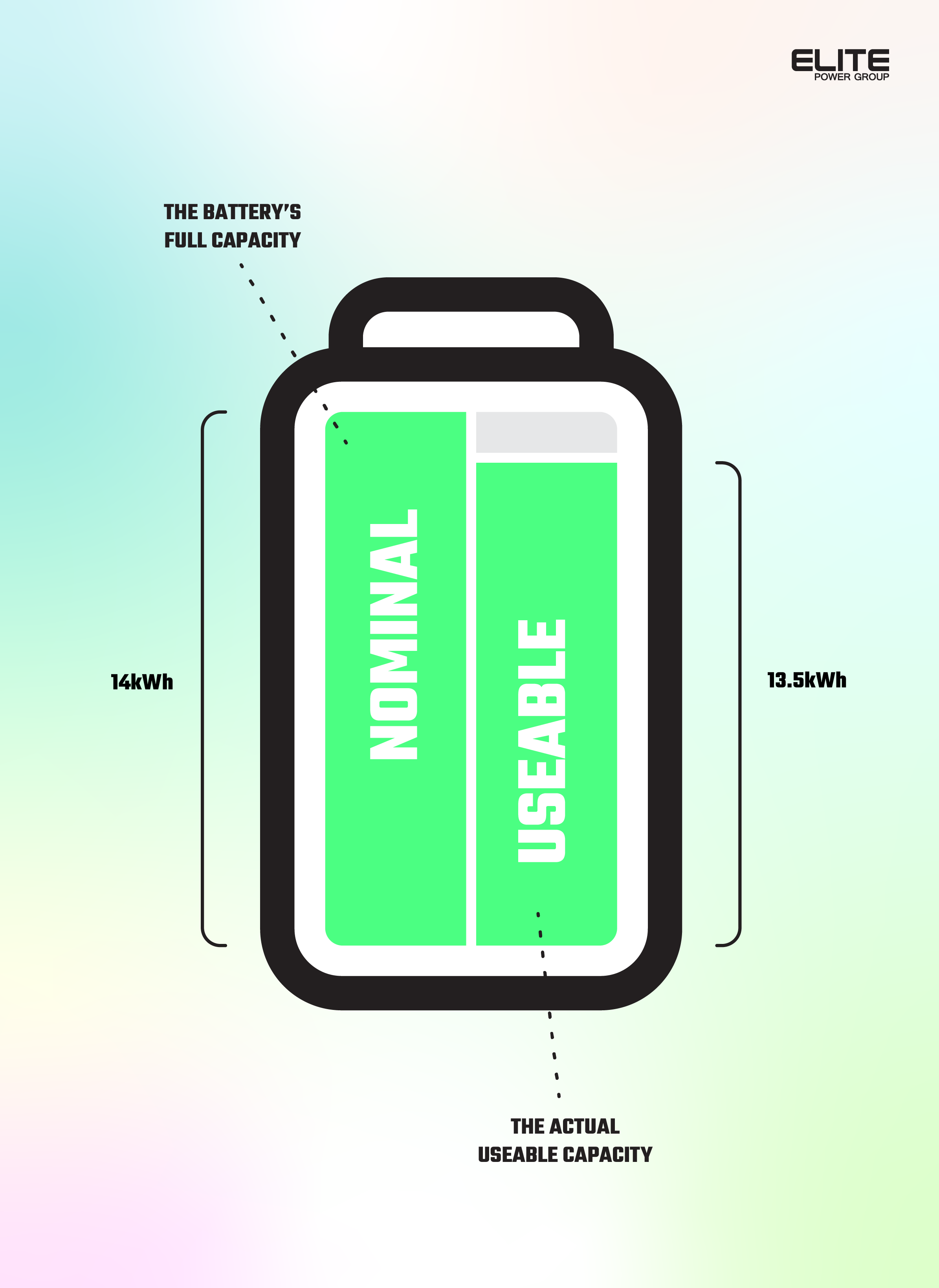
One thing worth knowing: most batteries list two capacity figures on their spec sheets.
|
Nominal capacity is the absolute total the battery cells can hold at 100% charge. |
Useable capacity is the amount you can actually access in normal use, which is always the same as or slightly lower than nominal. |
The difference exists because regularly cycling a battery to its absolute limits degrades it faster, so manufacturers set a protected range to extend the battery's lifespan.
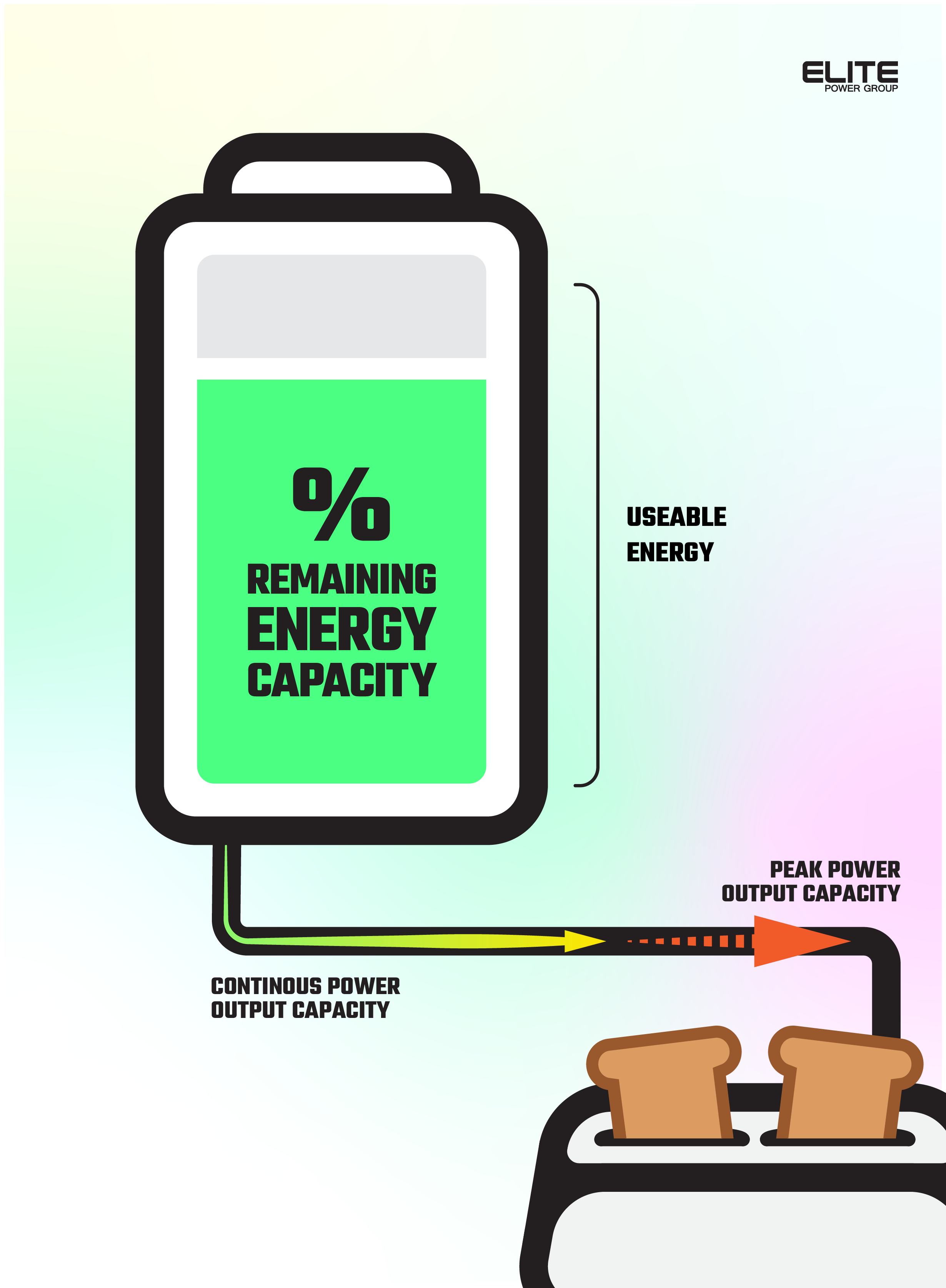
Power output is how much energy a battery can deliver at any given moment, measured in kilowatts (kW). Where capacity tells you how long the battery lasts, power output tells you how much it can do at once.
Back to the water tank analogy: power output is the size of the tap. A large tank with a small tap delivers water slowly. A small tank with a large tap delivers it fast but runs out quickly.
For home batteries, higher power output means you can run more appliances simultaneously, which matters most during grid outages or heavy evening usage.
Batteries list two power output figures: continuous and peak. Continuous output is the sustained rate the battery can deliver indefinitely - this is the number to plan around. Peak output is a higher burst available for seconds only, useful for handling appliance startup surges but not a reliable indicator of day-to-day performance.
The two specs interact to determine what a battery can actually do in your home. A simple formula: battery runtime (hours) = useable capacity (kWh) divided by load (kW).
A 13.5kWh battery powering a 4.5kW average home load lasts 3 hours. The same battery powering a 9kW load (ducted AC plus cooking) lasts 1.5 hours. Capacity sets the total; power output sets the maximum load the battery can sustain.
How the batteries we install compare:
|
Battery |
Nominal Energy |
Useable capacity |
Continuous output |
|
Tesla Powerwall 3 |
14 kWh |
13.5 kWh |
11.5 kW |
|
Sungrow SBR128 |
12.8 kWh |
12.8 kWh |
Inverter-dependen |
|
Sungrow SBH200 |
20 kWh |
20 kWh |
Inverter-dependent |
|
BYD Battery-Box HVM 22.1 |
22.1 kWh |
22.08 kWh |
Inverter-dependent |
|
GoodWe ESA 16 |
22.08 kWh |
15.4 kWh |
7.6 kW |
|
Fronius Reserva 15.8 |
16.71 kWh |
15.8 kWh |
Inverter-dependent |
The inverter-dependent note for Sungrow, BYD and Fronius means their power output is set by the paired hybrid
inverter
rather than the battery itself. Tesla Powerwall 3 and GoodWe ESA have built-in inverters, so their published continuous output is the
definitive number.
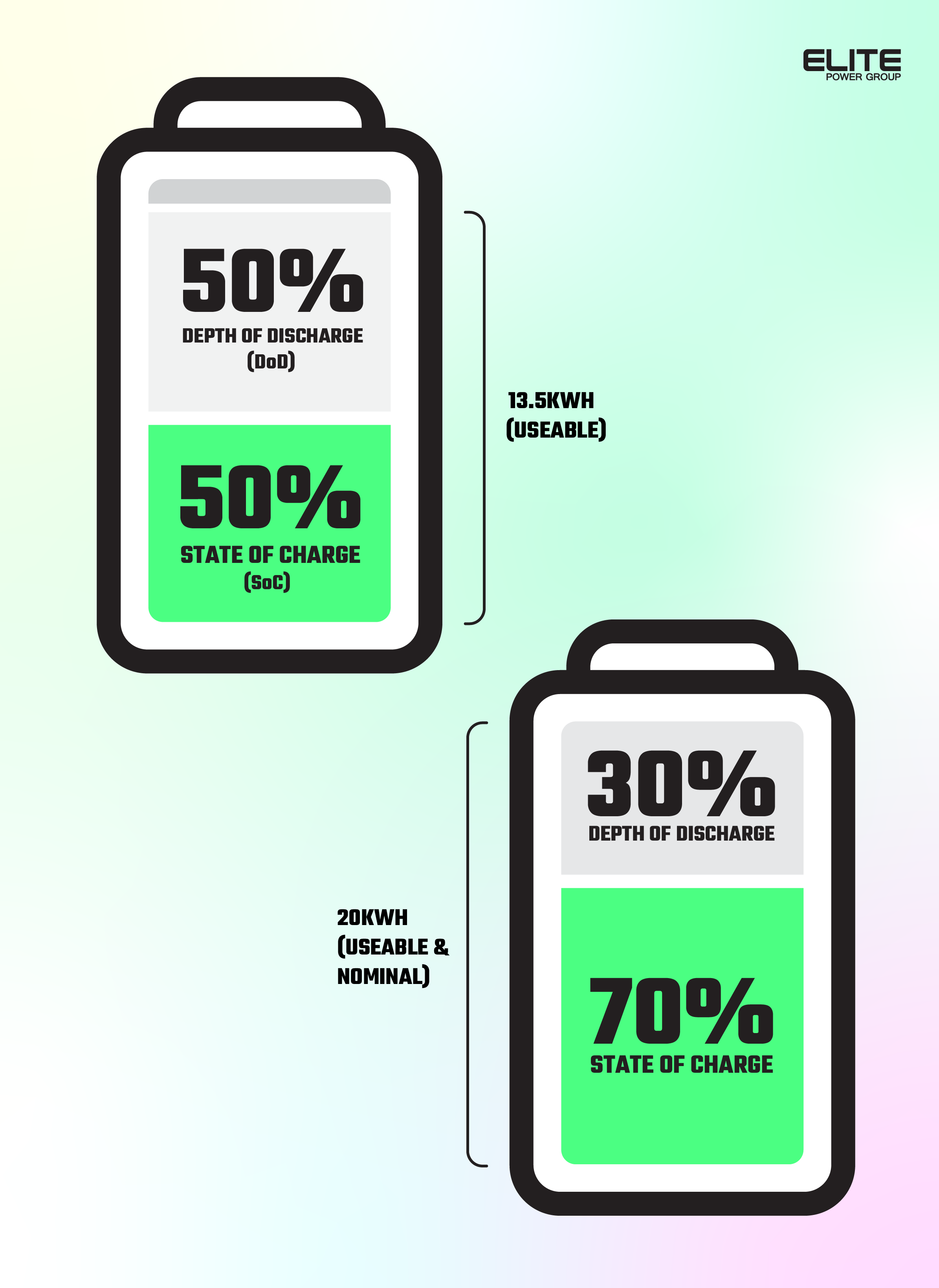
State of charge is the current energy level of your battery expressed as a percentage, exactly like the battery indicator on your phone. 100% means fully charged, 0% means empty.
SoC is how your battery app reports available energy at any moment. The Tesla app, Sungrow's iSolarCloud, and Fronius Solar.web all display SoC in real time, letting you see how much stored energy is available before the sun rises or the grid goes down.
Most battery owners set a minimum SoC reserve - typically 10–20%, that the system holds back for grid outages rather than depleting through normal daily use.
Depth of discharge is the flip side of SoC. Where SoC measures how much is left, DoD measures how much has been used, also as a percentage.
A battery sitting at 60% SoC has a 40% DoD. A battery drained to 0% has reached 100% DoD.
DoD matters because it directly connects to how the battery ages. Regularly discharging a battery to high DoD levels, pushing it close to empty every day - degrades the cells faster over time. This is exactly why manufacturers set useable capacity below nominal: they are building a protected range into the battery's operating parameters to prevent routine deep cycling.
Some batteries, particularly those using LFP (lithium iron phosphate) chemistry, are more tolerant of high DoD cycling and advertise 100% depth of discharge as a result. Sungrow SBR and SBH both do this. It is a genuine advantage for maximising useable storage over the battery's lifetime.
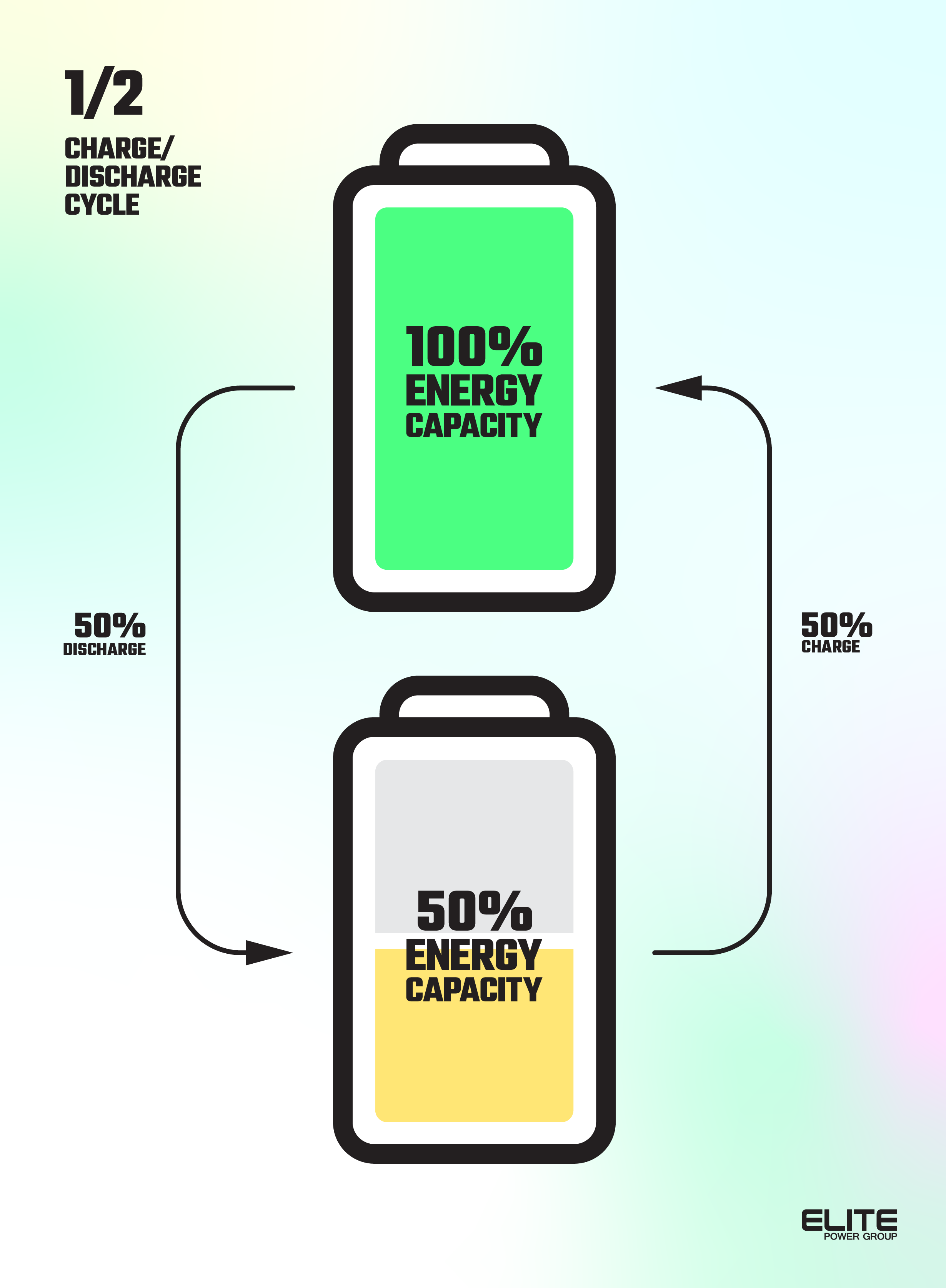

A charging cycle is one complete charge and discharge sequence. Charging from empty to full and discharging back to empty counts as one full cycle. In practice most home batteries do partial cycles, charging from 20% to 90% during the day and discharging back to 20% overnight, which counts as roughly 0.7 of a cycle.
Cycle count matters because it connects back to DoD and battery longevity. The more deeply a battery is cycled each day, the faster it accumulates cycle count and the sooner the warranty's cycle limit is approached.
Most battery warranties are structured as 10 years or a maximum number of cycles - whichever comes first. For typical residential partial cycling, the 10-year period expires well before the cycle limit is reached. The cycle limit becomes more relevant for batteries that are cycled multiple times per day, such as those participating in virtual power plant programs that discharge and recharge on demand.
The practical takeaway: for most homeowners, cycles are not a day-to-day concern. Understanding that deeper daily discharge means faster cycle accumulation is enough - which is another reason the useable capacity floor built into your battery is working in your favour.
It depends on what you are trying to achieve.
If your priority is covering evening electricity costs and running everyday appliances overnight, capacity matters more. A larger battery stores more energy and reduces how often you draw from the grid after the sun goes down.
If your priority is backup power during outages and running heavy appliances simultaneously, power output matters more. A battery that cannot sustain your ducted air conditioning alongside cooking is not useful in a summer blackout regardless of how much energy it stores.
For most Australian homeowners the answer is that both matter, and the right battery balances them to suit your specific usage and goals.
If you are working out what capacity suits your household, our battery sizing guide covers that in detail. If you are ready to compare which brands offer the right balance for your situation, see our battery brand comparison.
Everyone, including you, owns a battery of some sort. Knowing elements of your battery can help you find the best way to get longer battery life and prolong the health of your battery in the long term. For solar owners, knowing your battery gives you more insight into making the most out of your energy and quickening your return-on-investment.
Explore whether rooftop or ground mounted solar systems are better for homes, farms, and remote properties needing solar PV power in Australia.
Read moreThe journey of bidirectional charging in Australia has hit a milestone with the recent approval of the new standard for vehicle-to-grid (V2G) charging for 2025.
Read moreFor cabins, homes, and sheds with limited or no access to grid energy, getting an off grid solar and battery storage system may be worth it in NSW in 2025.
Read moreEveryone has seen a solar installation a normal roof like tin or tiled roofs, but have you ever seen a solar installation a roof made of Brass? Well we did one...
Read moreWith the release of the new Clean Energy Council (CEC) H1 2024 report on solar and battery storage, it gives an idea of the upward path of Australia’s renewable energy adoption.
Read moreAmber & ARENA have started trials for Vehicle-to-grid technology in NSW, Australia to help develop standards and framework in V2G and Bidirectional charging.
Read moreCompare Tesla Powerwall 2 vs Powerwall 3 in Australia. See differences in capacity, power output, dimensions, specifications, pricing & solar compatibility.
Read moreExplore solar battery fire risks, hazards, and statistics, and if solar batteries are safe to install for homes in NSW, Australia. (Spoiler alert.. they are!)
Read moreThough bidirectional charging isn't available, vehicle-to-grid is already turning heads in Australia with its potential to change energy consumption and distribution.
Read moreExplore how Australia's energy is evolving with t like Microgrids, DER's, Virtual Power Plants, & Demand Response, for solar and battery systems.
Read moreLearn alternating and direct current, and the differences between AC vs. DC with real-life examples and diagrams of power flow and voltage in Australia.
Read moreEverything NSW businesses need to know about commercial battery storage - costs, benefits, peak shaving, backup power, and how to choose a system.
Read moreIn the new 2024 CEC report, they found that renewable contribution in the overall supply of energy in Australia, produced 40% of Australia’s total electrical supply.
Read moreSo you've invested in solar to reduce your electricity bills, but since then your bills are still high? Explore why your energy bills are still high even after solar.
Read moreLearn electricity tariffs like single-rate, controlled loads, and time-of-use tariffs where on and off peak pricing occurs through retailers like energy australia.
Read moreExplore the differences between single phase vs. three phase power, and how 1 phase and 3 phase electricity works with real-life examples in Australia.
Read moreIf your solar panels are dirty, explore easy ways to DIY clean your solar panels, or when to get your system cleaned by a professional solar cleaner in Australia.
Read moreBatteries store energy as chemical potential energy, released as electrical current once connected to a circuit. Learn how batteries store & release energy.
Read moreNow is the best time to invest in solar panels.. here are 4 reasons why Australians should invest in solar energy before it's time runs out for 2024.
Read moreExplore the National Electricity Market (the NEM), and how it interconnected 5 states with electricity distribution to balance demand and supply in Australia.
Read moreDiscover how agrivoltaics can benefit farms by combining agriculture and solar energy to increase sustainability and agricultural production in NSW.
Read moreThe energy required to heat hot water is quite high and for most Australian households. Here are some strategies on how to save on your hot water heating bill.
Read moreWhat's the best Solar EV Charger? Zappi or the Wattpilot? We have put together a side-by-side comparison, including the pro’s and con’s for both EV chargers.
Read moreWith booming solar adoption, Newcastle is quickly becoming a sustainable region with homes and businesses adoption the technology. What's happening?
Read moreDifferences between bidirectional Vehicle-to-Grid (V2G), Vehicle-to-Home (V2H), Vehicle-to-Load (V2L), and compatible chargers and EVs in Australia.
Read moreOur team attended the Electric Vehicle open day in Lake Macquarie hosted by Lake Macquarie City Council, and what a day! From all the fun events, to the informative aspects, everyone definitely got something out of the day.
Read moreRenewable News Articles
Sign up for new article updates - we don't spam.
We've invested in becoming fully-licenced and qualified installers to ensure Newcastle homes and businesses
get the best solar, battery, and electrical systems available. We want to assist Newcastle's renewable energy revolution with quality
installations for maximum customer satisfaction.
Certified solar system installers near you.
Get CEC-Approved Battery Installations.
Fully-licenced electricians in Newcastle.
Convenient EV charging stations for properties.
Leave a Comment