Hunter Valley's Leading Residential & Commercial Solar Installers

Hunter Valley's Leading Residential & Commercial Solar Installers
Posted 19 Mar
Want the latest in energy, solar, and savings?Subscribe to our newsletter – we don’t spam!
Finding the right battery for your property is already hard enough with hundreds of brands to choose from, let alone technical aspects like 'AC-coupling' and 'DC-coupling'? What does that even mean?
The good news is that it is much easier to understand than it sounds. Let's explore battery coupling, and how your solar system and configuration will determine how you use your energy.
Quick answer: AC-coupled batteries connect via your switchboard and work with any existing solar inverter — making them the go-to for retrofits. DC-coupled batteries connect directly through a hybrid inverter for better efficiency, and are the preferred choice for new solar-plus-battery installations. The right answer depends on whether you already have solar and what inverter you have.
The batttery terms coupled & coupling are simply another way of saying connected.
AC coupling and DC coupling refers to the way a battery is connected to a new or existing solar system, which both serve different purposes.
A solar system generates DC electricity which needs to be converted to AC electricity to be used in a home. Depending if your battery is AC or DC-coupled, it will determine how many electricity conversions there are before you use it.
What does AC-Coupled mean? AC-coupling is when a battery is connected after the inverter as it has its own built-in inverter. AC-coupled batteries are generally used for retrofitting to existing systems.
What is a DC-Coupled battery system? DC-coupled solar batteries are when the battery is directly connected to a hybrid inverter which manages both the solar and battery. This is the ideal choice for new system installations.
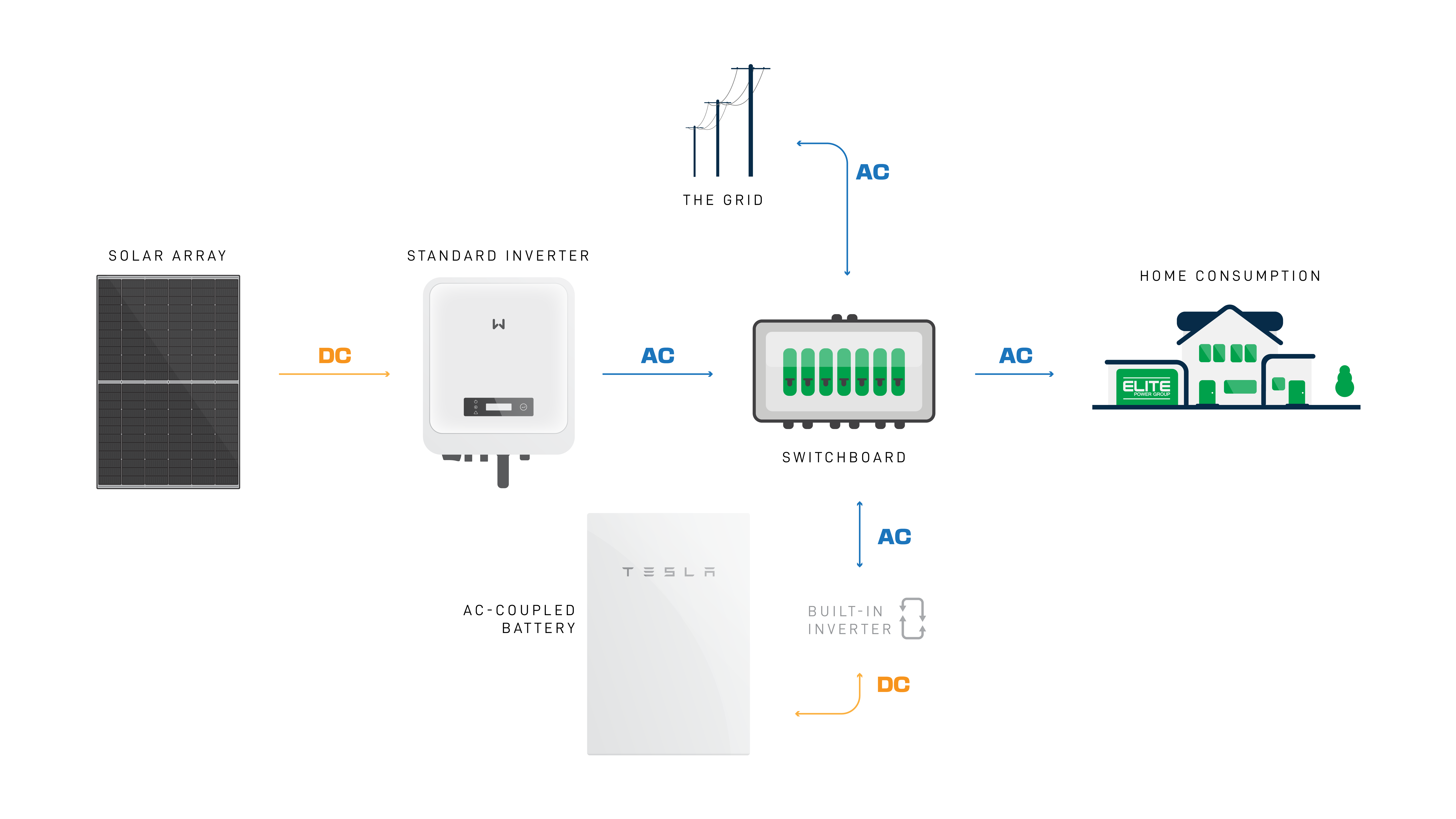
Using this AC-coupled battery diagram, you can see that the solar and inverter system is separate to the battery. In this arrangement, the AC-coupled battery is retrofitted to the existing system, and looks after its own DC and AC energy conversion with the built-in inverter.
Because the AC-coupled battery has its own built-in inverter, this removes the requirement for a hybrid
inverter
which enables broader compatibility and accessibility for existing system owners.
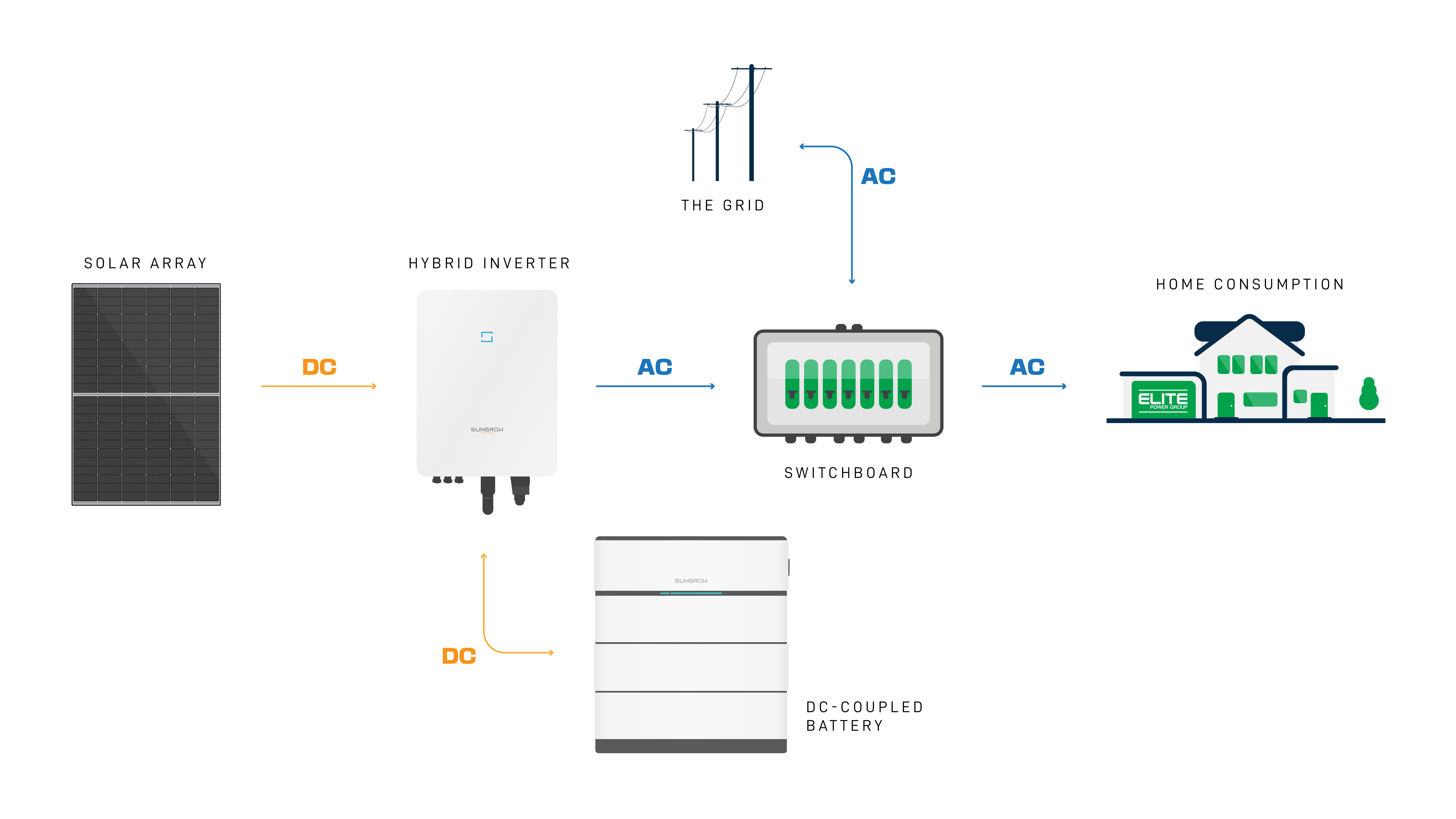
Unlike an AC-coupled system, a DC-coupled system is directly integrated with a compatible, battery-ready hybrid inverter which essentially looks after managing the battery and solar generation in one unit.
The hybrid DC-coupled battery system is configurable and customisable to either send the DC energy straight to the battery, or convert the DC power into AC for home appliances or feeding to the AC grid. Because of the reduced amount of conversions, it also increases efficiency.
|
|
AC-COUPLED
|
DC-COUPLED |
|
How it connects |
Via AC switchboard, independent of solar inverter | Direct DC connection via hybrid inverter |
|
Number of Conversions |
3 (DC to AC to DC to AC) | 1 (DC to AC at point of use) |
|
Round-trip efficiency |
90-94% |
96-98% |
|
Retrofits to existing systems |
Works with most inverters |
Only compatible with hybrid inverters |
| Best for |
Retrofitting to existing solar systems | Newer solar & battery systems |
|
Advantages |
|
|
|
Disadvantages |
|
|
The coupling type of a battery is determined by its inverter architecture - whether it has its own built-in inverter (AC-coupled) or connects directly to a compatible hybrid inverter (DC-coupled). The table below covers the main home battery brands available in Australia and how they connect.
| BATTERY |
COUPLING |
BUILT-IN INVERTER |
BEST FOR |
| Tesla Powerwall 2 | AC-coupled |
Yes |
Retrofitting to most existing solar systems |
| Tesla Powerwall 3 |
AC (retrofita) & DC-coupled (all-in-one) | Yes + Built-in Solar Inverter |
New Installs for retrofits - most flexible option |
| GoodWe ESA |
AC & DC-Coupled |
Yes, built-in solar inverter module |
Adding high-capacity storage to existing systems |
| Sungrow SBH / SBR |
AC & DC-Coupled | No built-in inverter |
New Sungrow-based inverter systems |
| Fronius Reserva |
DC-Coupled | No built-in inverter | Fronius-based solar inverter systems |
| BYD Battery-Box |
DC-Coupled | No built-in inverter | BYD-based solar inverter systems |
Tesla Powerwall 3 is neither in the traditional sense - it is an all-in-one system with its own built-in solar inverter. This makes it different from both classic AC-coupled and DC-coupled configurations.
Here is how each Powerwall generation works:
Tesla Powerwall 2: AC-coupled. It has its own built-in battery inverter and connects at the AC switchboard level, independently of the solar inverter. Works with any existing solar setup regardless of brand. This is the classic AC-coupled battery.
Tesla Powerwall 3: All-in-one. It includes a built-in solar inverter as well as the battery inverter. It connects directly to the solar panels (DC input) as well as the grid. In a new installation, it replaces the need for a separate solar inverter entirely. When retrofitting to an existing system, it can AC-couple at the switchboard like Powerwall 2. So Powerwall 3 can operate as either depending on installation configuration.
The practical implication: if you are adding Powerwall 3 to an existing solar system, it connects AC-coupled via the switchboard and your existing inverter stays in place. If you are installing solar and Powerwall 3 together from scratch, it acts as the all-in-one inverter and the DC coupling question is largely bypassed.
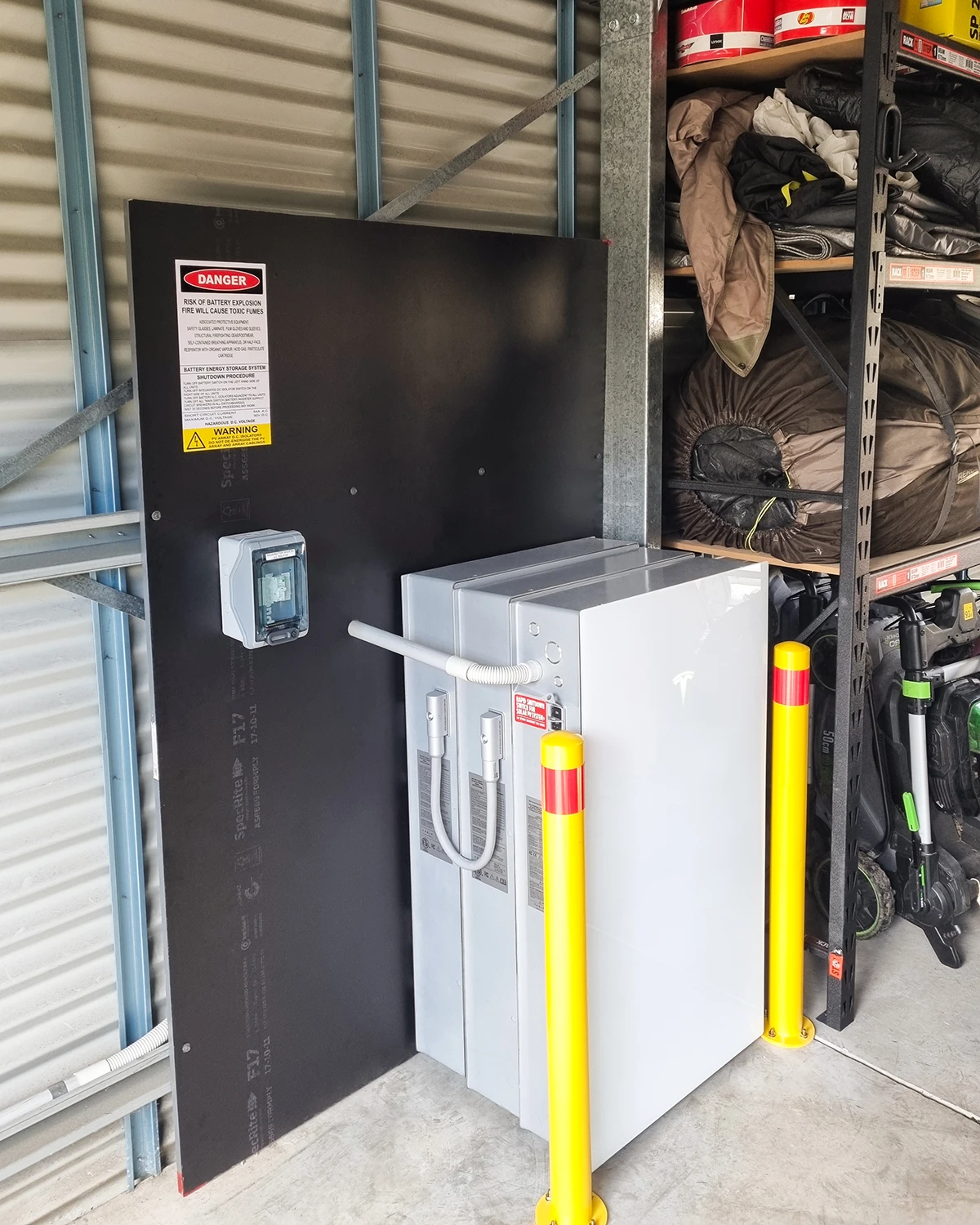
DC-coupled systems are more efficient, with round-trip efficiency of 96–98% compared to 90–94% for AC-coupled systems. The difference comes down to energy conversions - DC-coupled requires one conversion, AC-coupled requires three.
Because DC-coupled energy storage requires fewer conversions between AC and DC, it means that more energy can be utilised and available for immediate consumption.
Every time electricity is inverted from AC to DC and the other way around, around 1-5% of power is lost to inefficiencies of the inversion process. This means that in an AC-coupled battery system, electricity is converted 3 times to allow for both storage and consumption, as opposed to the DC-coupled single conversion.
Even though DC-coupled systems are generally more efficiency, it is important to note that the conversion losses aren't significant
and won't really be noticeable.
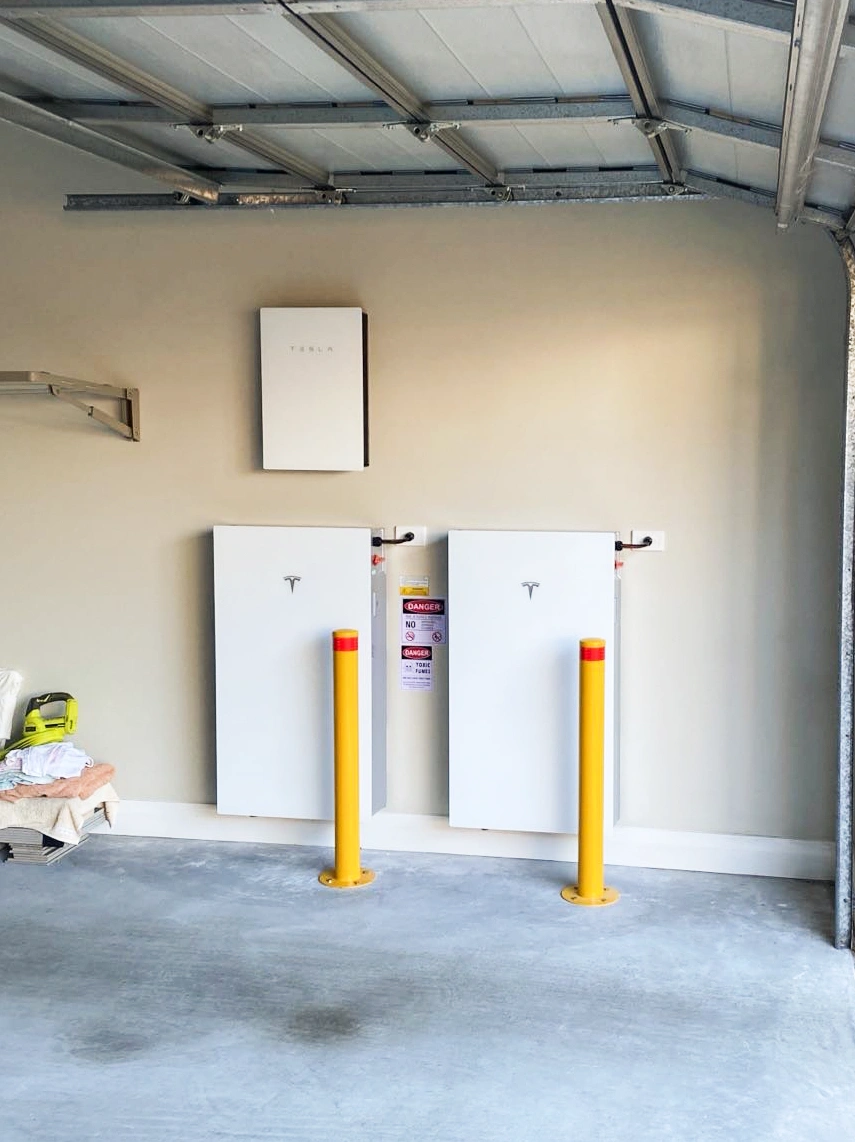
Image: Triple Tesla Powerwall 3 installation (DC-coupled).
If your home has existing solar without a hybrid solar inverter, an AC-coupled battery may be better suited for you. If you're installing an entirely new solar system, investing in a hybrid DC-coupled battery system is the way to go.
For homes with existing solar, it may be more cost-effective to retrofit an AC-coupled battery to your solar system.
For homes getting a new solar system, a DC-coupled system might make more sense for longevity and future compatibility.
If you’re looking at getting a battery for your property and are unsure whether an AC or DC-coupled battery would be better, we highly-recommend contacting your local solar battery installers to determine the right solution for you.
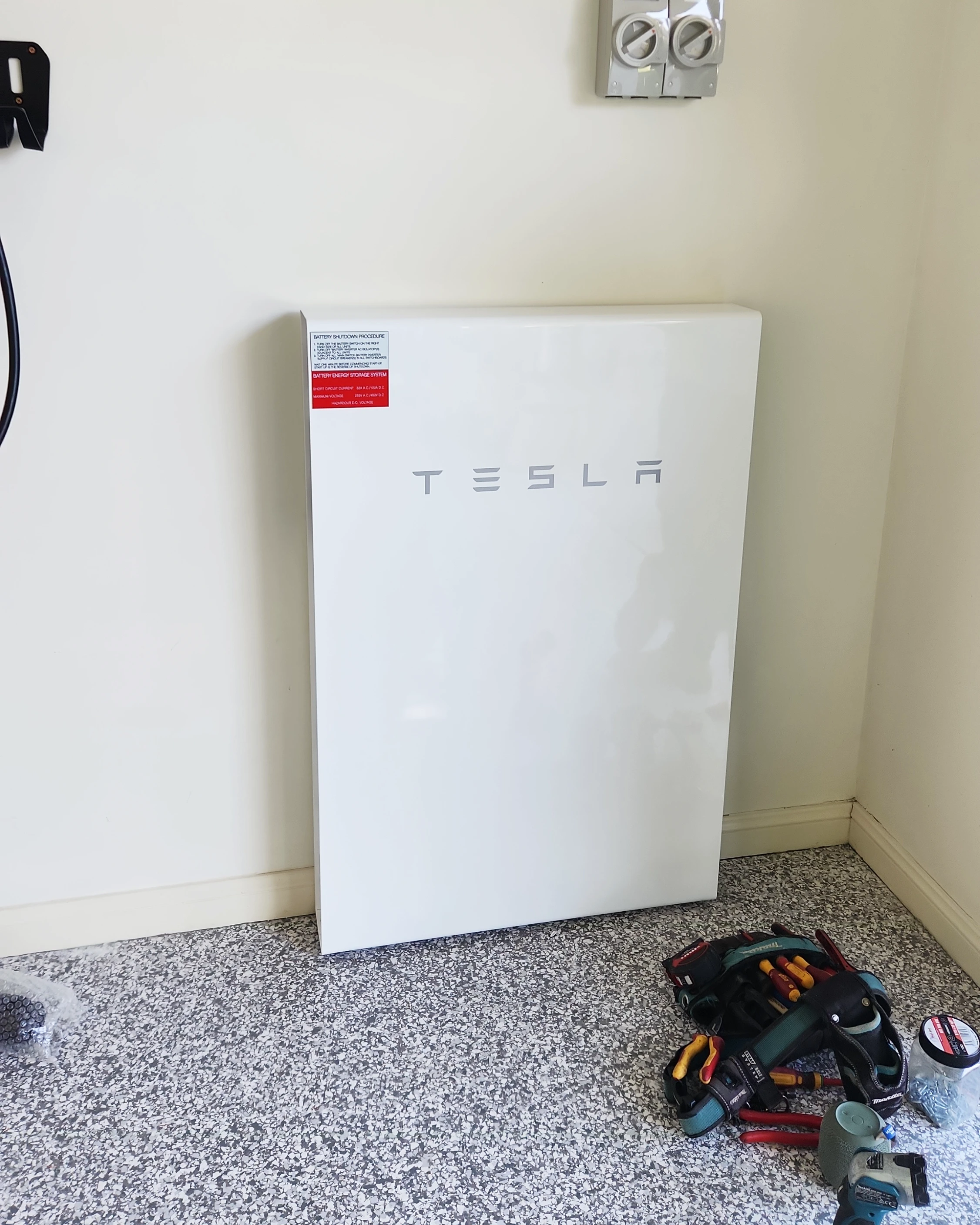
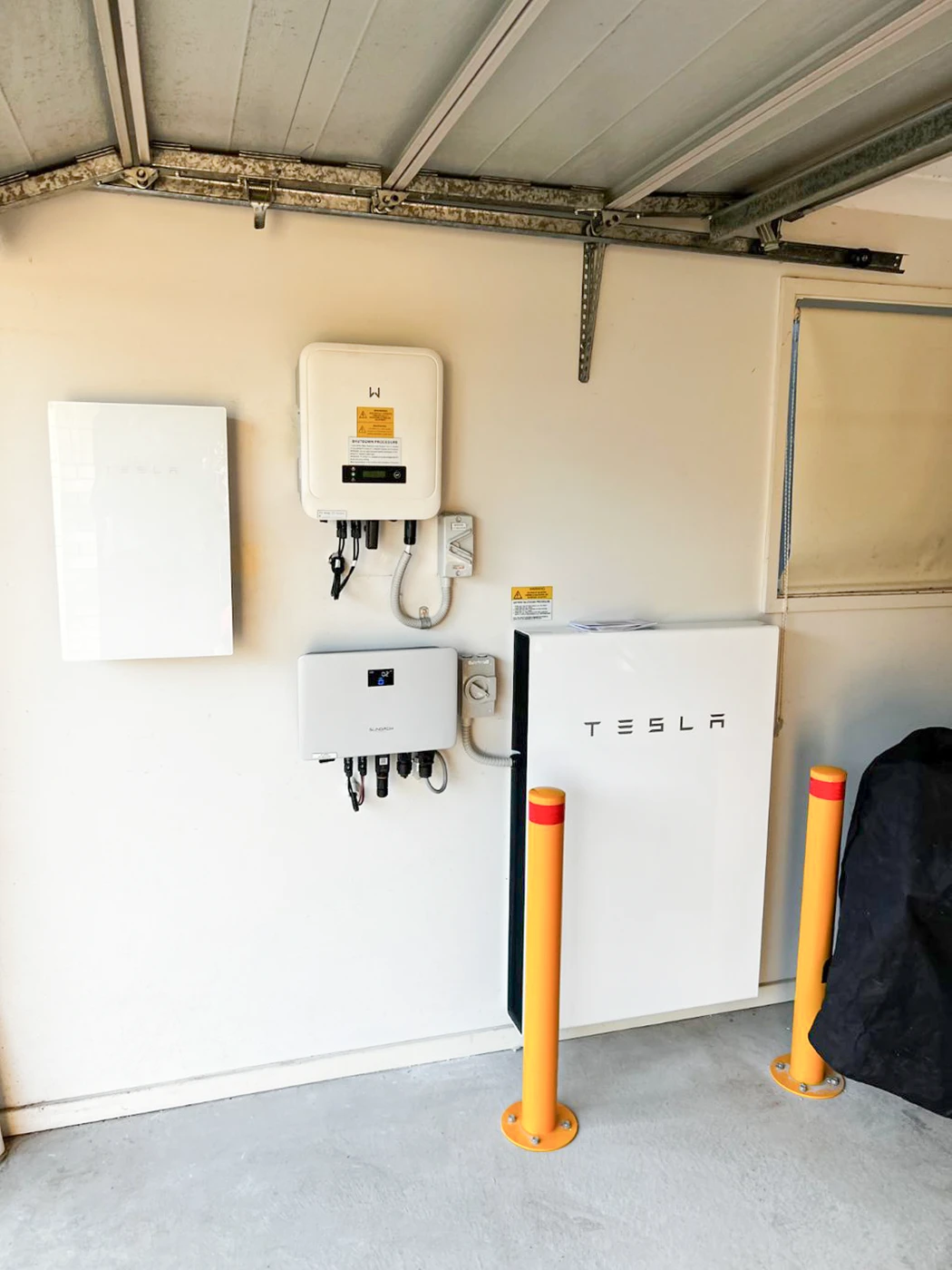
Image: AC-coupled Tesla Powerwall 2 installation. (Now discontinued)
With so many brands, models, capacity, and feature options, where in the world do you start in finding the best energy storage for your home? Well good news, it's not as difficult as it may seem. Whilst we have an article on determining the best battery for homes in Australia, here are some estimated capacity options.
Most homes will use a moderate amount of energy. For the average household where residents are working most of the day, a 13-15kWh battery should be sufficient in helping offset daily consumption.
For flexibility in energy capacity, a 16-20kWh battery will enable a little more excess energy to sell into the grid, and accelerate programs like Amber. It will also support homes with more residents and higher usage.
With higher investment budgets, those who want even more juice in their energy capacity can invest in anything from 20-40kWh+ of energy capacity to really take advantage of feed-in-tariffs and high consumption offsetting.
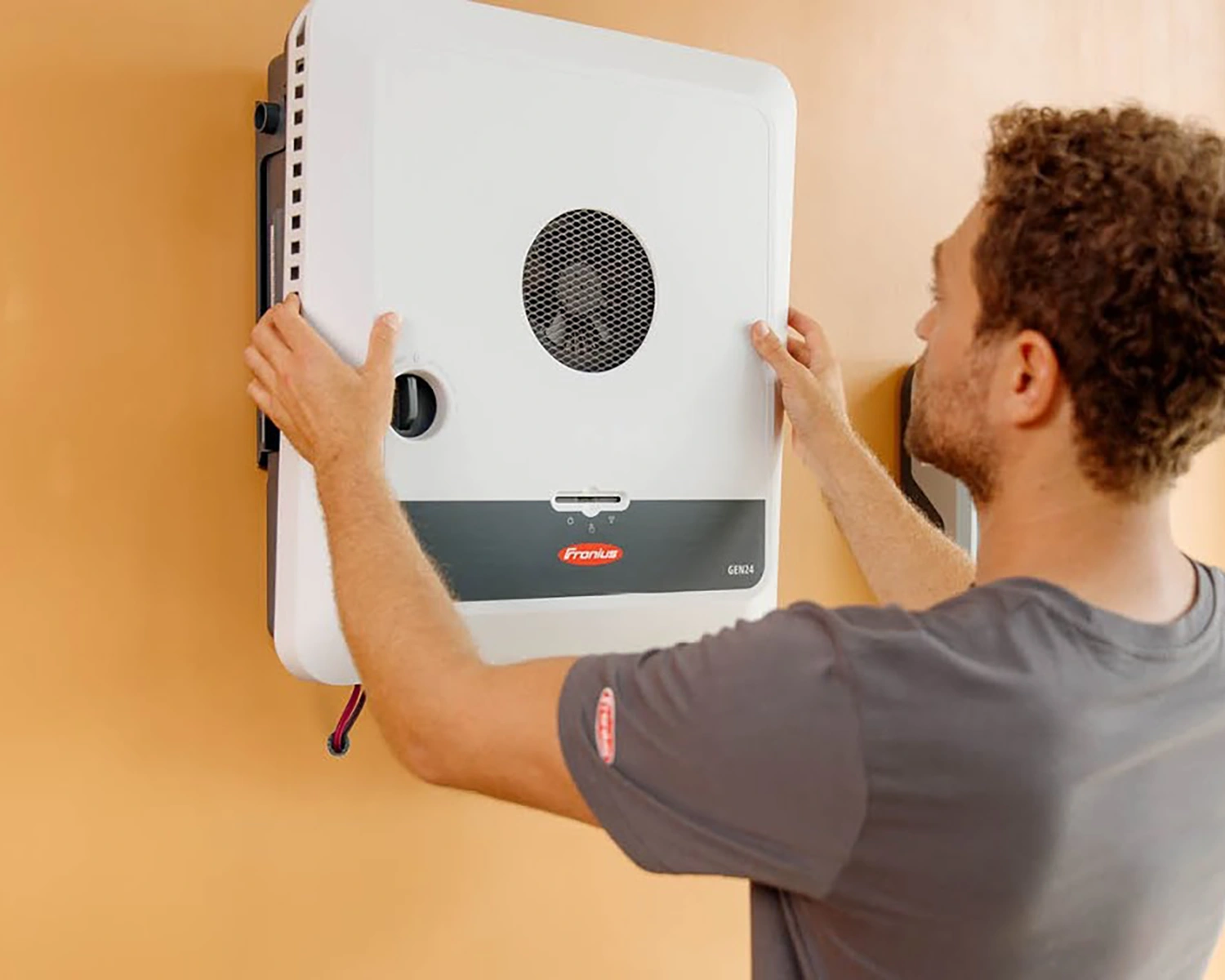
A grid-tied (or string) inverter converts DC power from your solar panels into AC electricity for household use and grid export. That is all it does. If the grid goes down, a grid-tied inverter shuts off automatically with no solar, no backup.
A hybrid inverter does everything a grid-tied inverter does, plus manages a DC-coupled battery in the same unit. It can draw from solar, the battery, or the grid simultaneously, and switch between them automatically - including during a grid outage. This is what makes hybrid inverters the standard recommendation for any installation where battery storage is planned now or in the future.
The trade-off is cost. Hybrid inverters are more expensive upfront, and battery compatibility. DC-coupled batteries must match the hybrid inverter brand. If you want to add storage to an existing grid-tied system without replacing the inverter, an AC-coupled battery is the practical alternative.
Image: Fronius GEN24 Hybrid Solar Inverter
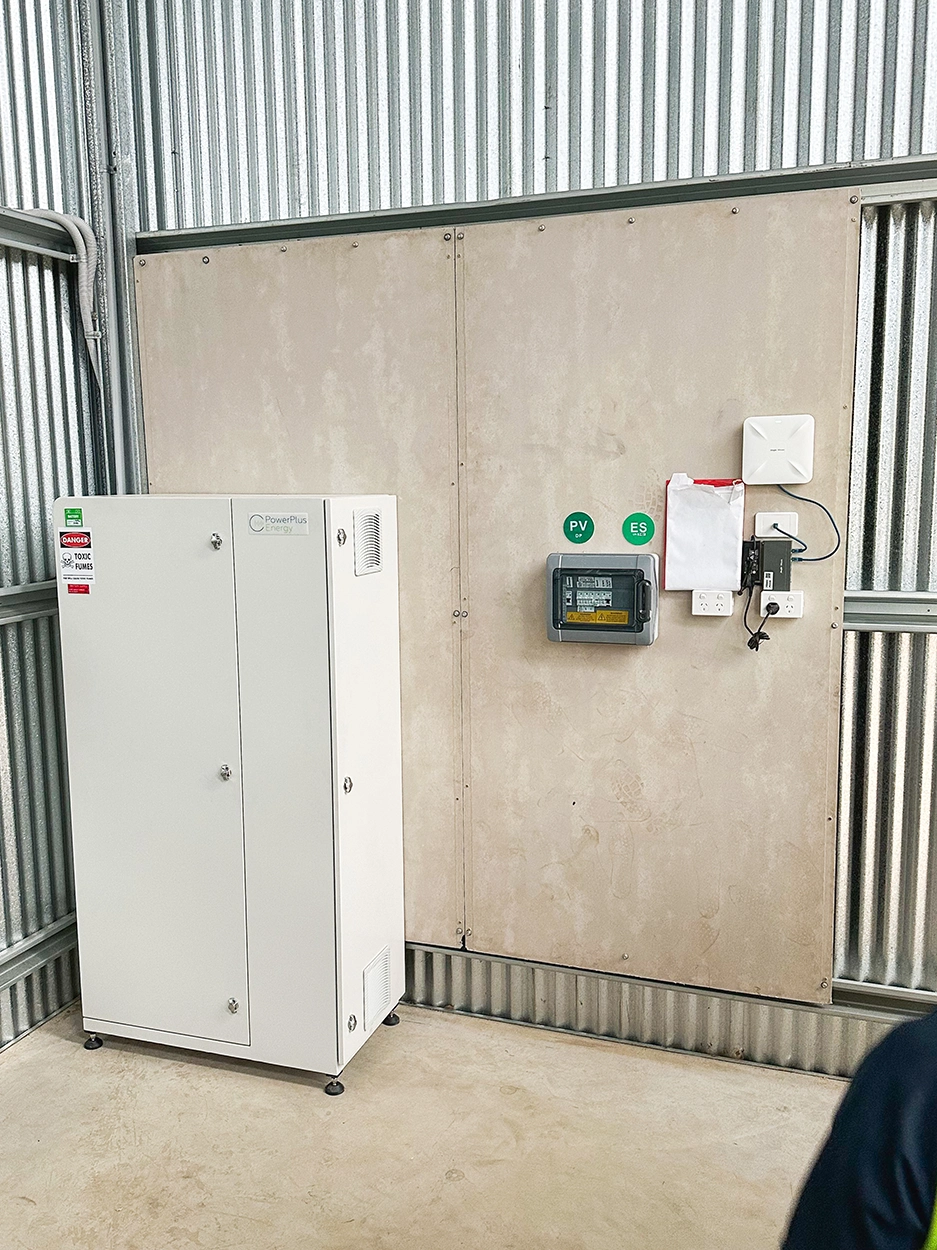
For off-grid properties, DC-coupled battery storage is chosen because of seamless integration with off-grid solar inverters like Selectronic SP PRO's, which manages both solar and battery in the one unit.
Whilst it's not a dealbreaker, knowing you're getting the absolute most efficiency out of your solar system is always ideal, so DC-coupled battery systems are generally preferred by off-grid installers.
Image: Off-grid DC-Coupled PowerPlus Battery Cabinet
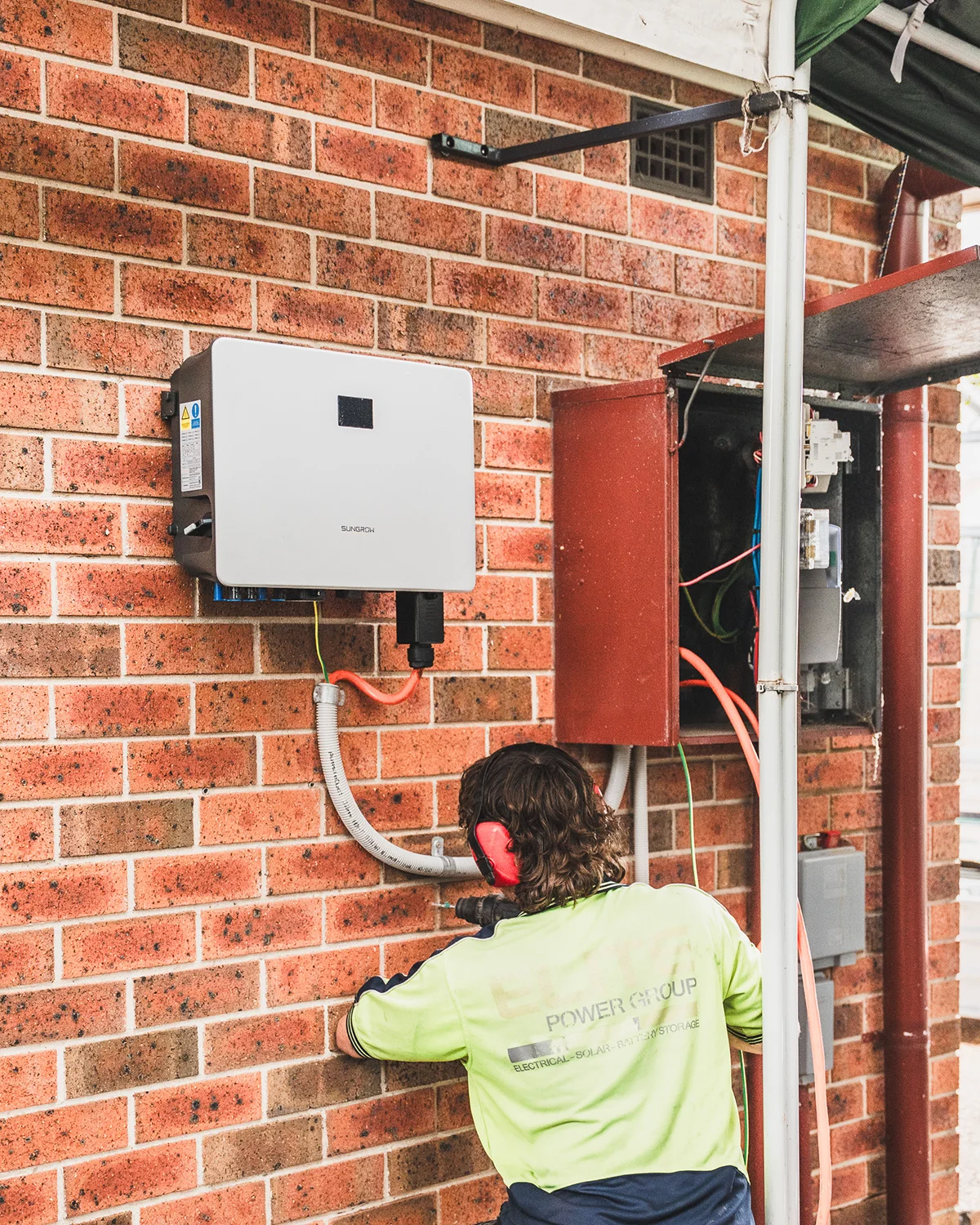
Your battery and inverter need to match your property's single-phase or three-phase electrical supply.
Most Australian homes run on single-phase supply. A single-phase hybrid inverter manages solar and battery across that single supply, which is sufficient for the majority of residential properties. Backup power during a grid outage is delivered on the same single phase.
Larger homes, most businesses, and properties with three-phase appliances (large ducted air conditioning, three-phase EV chargers, workshop equipment) run on three-phase supply. A three-phase hybrid inverter is required to manage solar and battery across all three phases and deliver proper backup capability across the whole property. Running a single-phase inverter on a three-phase property is possible but means backup power is limited to one phase only - a significant constraint for most homes.
Image: Single-phase Sungrow solar inverter installation.
Power output is how much electricity your battery can deliver at any moment. Measured in kW, this amount will depend on if your battery is AC or DC coupled.
For AC-coupled batteries, power output is set by the battery's own built-in inverter. Tesla Powerwall 3, for example, delivers up to 11.5kW of continuous output regardless of what solar inverter is installed alongside it, because it manages its own power conversion internally.
For DC-coupled batteries, power output is determined by the hybrid inverter, not the battery itself. A Sungrow SBH battery paired with a large Sungrow SH inverter can deliver higher output than the battery spec alone suggests, because the inverter controls how fast energy is drawn and converted.
Single-phase vs three-phase also matters here. On a single-phase property, the full rated output is available on one phase. On a three-phase property with a single-phase battery, that output is spread across all three phases - meaning each phase receives a third of the total. For homes with high three-phase loads (ducted systems, large appliances, EV charging), a three-phase inverter and battery configuration is recommended.
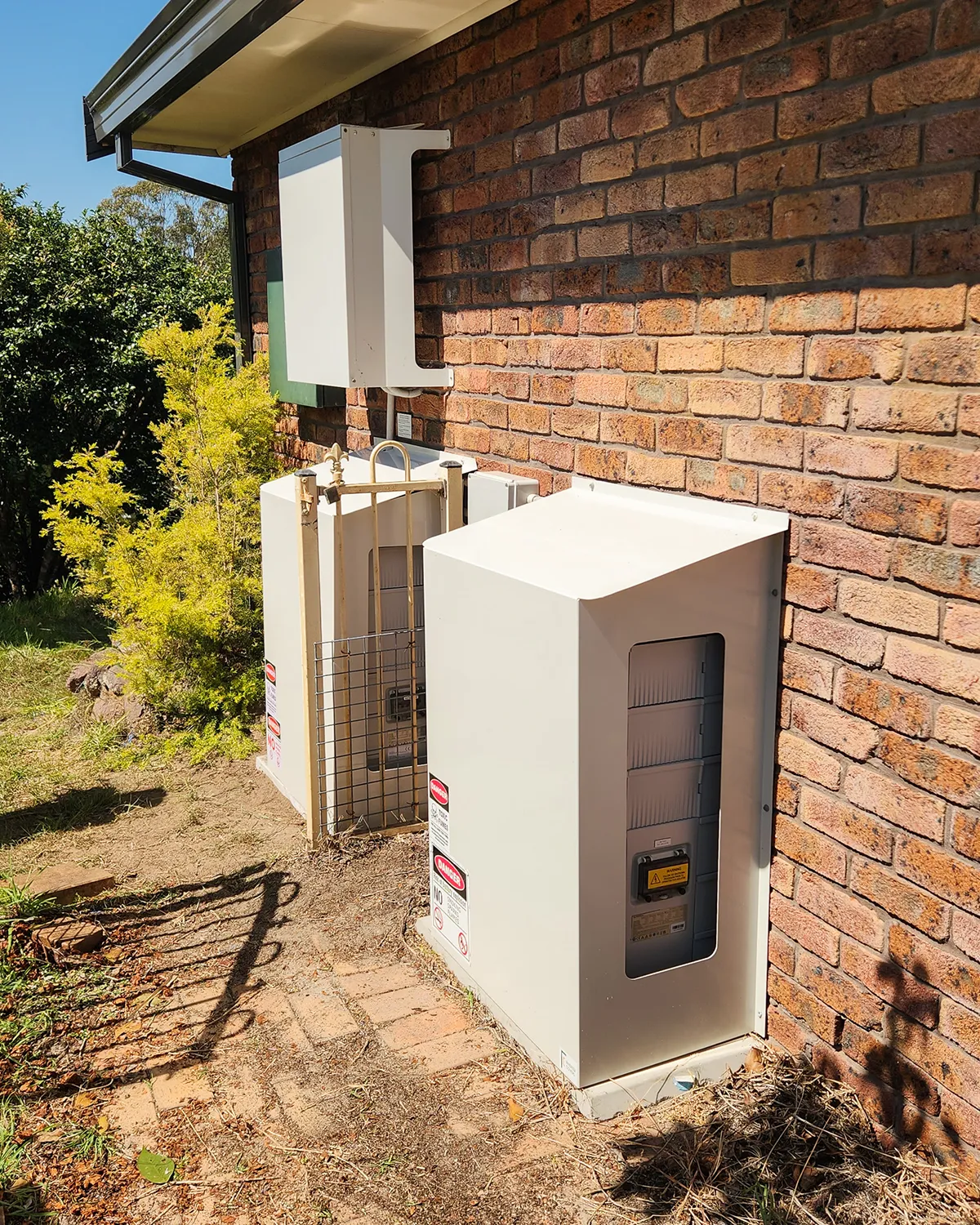
Image: Dual DC-Coupled Sungrow SBR Battery Storage
Whether you're an existing solar owner or someone who is looking into getting the right sized solar system installed, it is definitely recommended to research and determine whether a battery is a good investment for your energy.
Choosing from both DC and AC-coupled systems can both bring benefits to ensure you get a good return on your investment, as well as reliability and future upgrade capabilities.
If you're seriously considering what kind of battery to get, we offer free consultation and quoting for homes and businesses in the Newcastle and Maitland region, with SAA-approved solar and battery designers and installers here ready to help find the optimal, compliant energy system.
Not all batteries provide blackout backup by default. Learn what happens, what your battery is backing up, and how to stop your battery draining too fast.
Read moreFind available rebates & subsidies for solar systems, battery storage, and VPPs in NSW. Explore eligibility and maximise live incentives today.
Read moreNot sure which battery matches your solar system? Compare solar & battery size combinations, from 6.6kW to 13.3kW+, & find the right fit in Newcastle.
Read more
Renewable News Articles
Sign up for new article updates - we don't spam.
We've invested in becoming fully-licensed and qualified installers to ensure Newcastle homes and businesses
get the best solar, battery, and electrical systems available. We want to assist Newcastle's renewable energy revolution with quality
installations for maximum customer satisfaction.
Certified solar system installers near you.
Get CEC-Approved Battery Installations.
Fully-licensed electricians in Newcastle.
Convenient EV charging stations for properties.
Leave a Comment