Hunter Valley's Leading Residential & Commercial Solar Installers

Hunter Valley's Leading Residential & Commercial Solar Installers
Posted 15 Jul
Want the latest in energy, solar, and savings?Subscribe to our newsletter – we don’t spam!
When it comes to talking about electricity, many use the terms 'power' and 'energy' inter changeably, but did you know these actually represent to different aspects to your electricity? It is important to understand these 2 terms, especially if you're looking at investing in solar, battery storage, or electric vehicle charging in Australia.
Quick answer: Power (kW) measures the rate at which electricity is being used or generated right now. Energy (kWh) measures the total amount of electricity used over a period of time. Think of power as speed and energy as distance - a car travelling at 100 km/h (power) for 2 hours covers 200 km (energy). In electricity terms: a 2 kW appliance running for 3 hours uses 6 kWh. Your electricity bill charges you for energy (kWh), not power (kW). Solar panels are rated in kW (their peak output); batteries are rated in kWh (their storage capacity).
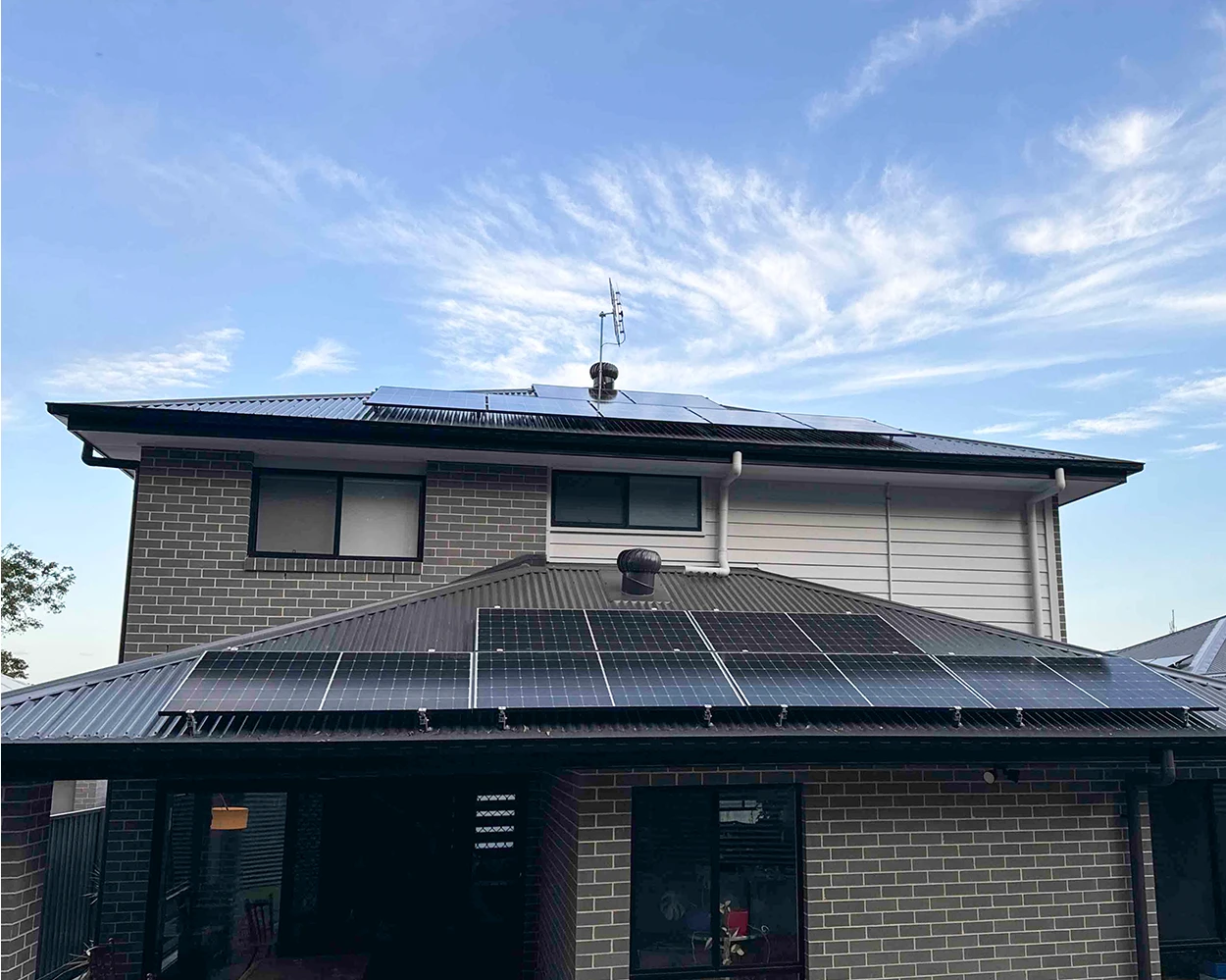
Power is the rate at which electricity is generated or consumed at any given moment, measured in watts (W) or kilowatts (kW). It tells you how hard something is working right now, not how long it runs, just the intensity at this instant.
One kilowatt equals 1,000 watts. Common power ratings for household appliances:
Power is like the flow rate of a tap. It tells you how fast water is coming out, not how much has filled the tank and it can change instantly as appliances switch on and off, and it drops to zero when nothing is running.
Is power the same as electricity? Not quite. Electricity is the broader term for the flow of electric charge. Power is the rate of that flow, a specific measurement within the world of electricity, measured in watts or kilowatts.
Energy is the total amount of electricity consumed or generated over a period of time, measured in kilowatt-hours (kWh). Where power tells you the rate at this moment, energy accumulates over time, it only ever goes up as long as something is running.
The formula is: Energy (kWh) = Power (kW) × Time (hours)
So a 2 kW appliance running for 4 hours uses 8 kWh. A 5 kW air conditioner running for 6 hours uses 30 kWh.
Energy is like the odometer on a car, it accumulates continuously and tells you the total distance covered, not just the current speed. Your electricity bill is charged in kWh. Every unit of electricity on your bill is 1 kWh.
Is kWh energy or power? kWh is energy, not power. The "h" (hours) is the clue. It's power multiplied by time, which gives you total energy. Power is measured in kW alone, without the time component.

The main difference between power and energy is how power is simply measures the rate of electricity, where energy represents the amount of time that power is being used.
| POWER |
ENERGY |
|
| Unit |
Kilowatt (kW) | Kilowatt-hour (kWh) |
| Measures |
Rate of electricity at any given moment | Total electricity used over time |
| Changes |
Instantly when appliances are switched on, and down when switched off | Gradually accumulates - never goes backwards |
| Analogy | Speed (km/h) |
Distance (km) |
| On your bill |
Not charged directly (excluding demand tariffs) | What you're billed for per unit |
| Solar relation | The total solar output capacity |
The amount of daily/annual generation |
| Battery relation | Total battery power input & output | Total battery capacity |
Why the power rating alone doesn't give a complete picture of energy usage: A 3 kW appliance running for 10
minutes uses far less energy than a 1 kW appliance running for 8 hours. Power tells you the intensity; energy tells you the impact on
your bill. A high-power appliance used briefly may cost less than a low-power appliance running all day. You need both the power rating
and the run time to understand actual energy consumption.

This is where most people get tripped up, because the units look almost identical.
kW (kilowatt) = power. The rate of energy use or generation at this moment. A 10 kW solar system can generate up to 10 kW when the sun is strong. that's its output capacity at peak conditions.
kWh (kilowatt-hour) = energy. The total accumulated over time. That same 10 kW solar system, running at an average of 5 kW across 8 hours of sunlight, generates 40 kWh in a day.
For solar and batteries, both numbers matter:
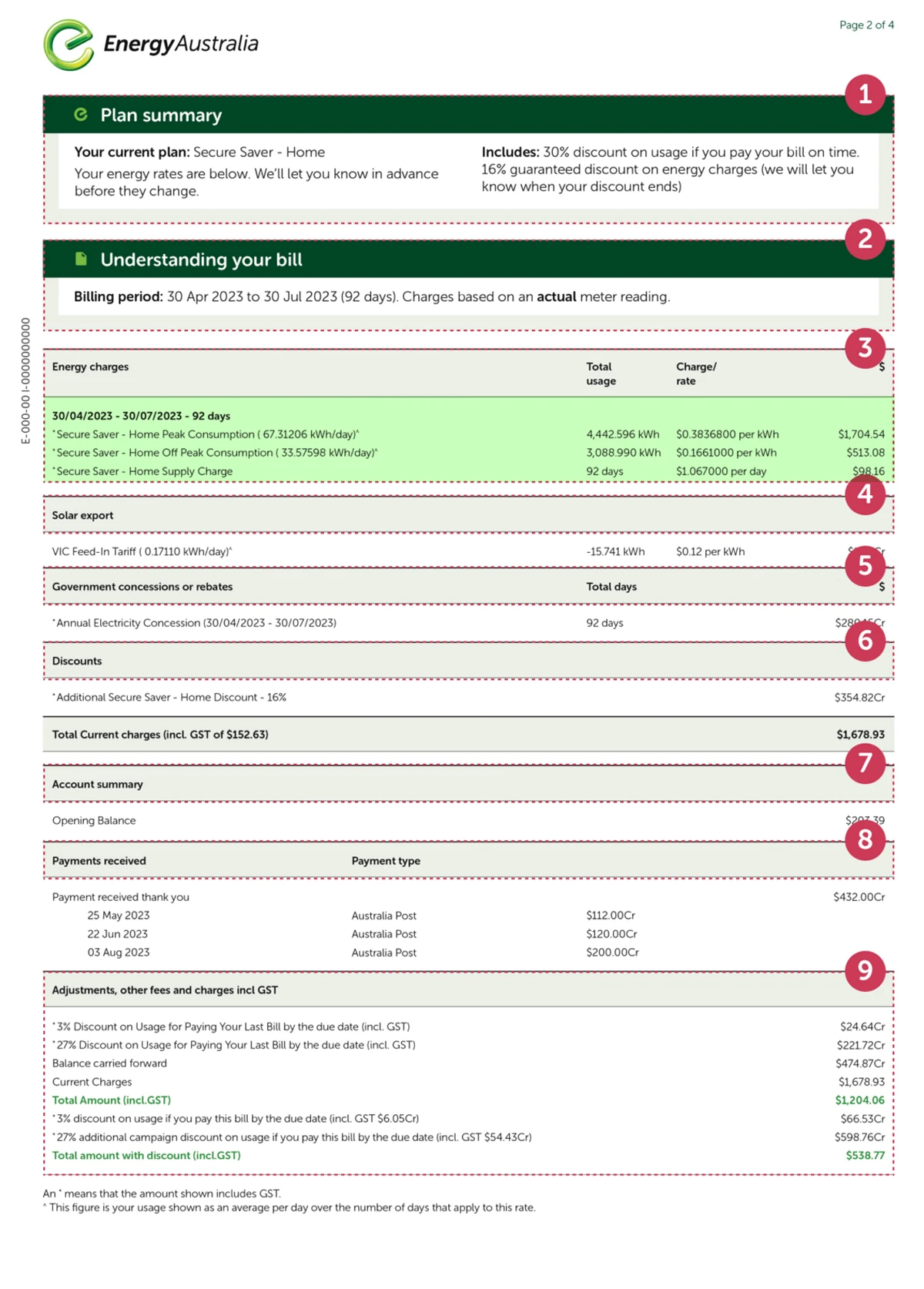
Your electricity bill is charged in kWh. The rate (say, 30c/kWh) multiplied by your consumption (say, 20 kWh/day) gives your daily energy cost ($6.00). The power level of each appliance doesn't appear directly on the bill, only the total energy consumed does.
Australian electricity is measured using several related units depending on what's being described:
Watt (W): the basic unit of power. Most small appliances are rated in watts. A phone charger draws about 20W; a lightbulb around 10W.
Kilowatt (kW): 1,000 watts. Used for household appliances, solar systems and EV chargers. A standard kettle is about 2 kW.
Megawatt (MW): 1,000 kW. Used for large commercial and utility-scale power generation.
Watt-hour (Wh): a unit of energy. 1 Wh = 1 W of power used for 1 hour. Typically used for small batteries (e.g. phone or laptop batteries).
Kilowatt-hour (kWh): 1,000 Wh. The standard unit for household electricity consumption, solar generation, and battery storage. What your electricity bill charges you for.
Megawatt-hour (MWh): 1,000 kWh. Used for large-scale commercial battery systems, grid storage, and utility-scale solar farms.
What is 1 unit of electricity? In Australia, 1 unit of electricity on your
bill = 1 kWh. When your bill shows 500 units used, it means 500 kWh.
Understanding power vs energy makes the numbers on solar and battery spec sheets a lot more readable.
Solar panels are rated in kW, their peak power output under ideal conditions. A 10 kW solar system means it can generate up to 10 kW at peak. In Australia, a 10 kW system typically generates 35–50 kWh per day depending on location, season and shading.
Batteries have two specs that both matter. A Tesla Powerwall 3 has 13.5 kWh of energy storage and 11.5 kW of continuous power output. The 13.5 kWh tells you how much it can hold. The 11.5 kW tells you how fast it can deliver or receive energy.
Your electricity bill charges you in kWh. The average Australian household uses around 18–22 kWh per day. A well-sized solar system can offset a significant portion of that during daylight hours; a battery stores surplus generation to cover evenings.
Demand tariffs (common for commercial customers) add a kW-based charge on top of the kWh energy charge, calculated on your peak power draw in any 15 or 30-minute interval during the billing period. This is why a solar system reduces your energy bill but doesn't always reduce demand charges.

So we've looked at power and energy in appliances and solar systems, but how does power and energy relate to electric vehicles? Using EVs as an example, we're met with an abundance of places where both power and energy are used.
Firstly, every electric car battery is measured in energy or kilowatt-hours, like how the BYD Sealion 7 has an 82.5kWh battery capacity.
This is not to be confused with phrases like '390kW of power'. This isn't referring to the battery capacity, but instead the power that the electric motor can output at its peak.
When it comes to electric vehicle charging, chargers are measured by power or kilowatts that refer the amount of power the charger can deliver to the battery. Chargers can range in power outputs, depending on AC or DC, however home AC chargers are usually 7-22kW depending on if your home is single or three-phase.
Electricity bills are measured in kilowatt-hours (kWh), as it refers to the total amount of energy you consume over time, usually each quarter. Energy providers look at both the amount of power consumed, and the duration it is consumed for.
Are Solar FiTs Energy? Additionally, you'll notice solar feed-in-tariffs are also measured in energy. This is to determine the amount of power you produced over an amount of time.
What is Power vs. Energy for Batteries? If you have a solar battery like Tesla Powerwall 3, it will have a total energy capacity which will in this case consist of 13.5kWh of energy, meaning if you're drawing 6.75kW of power from the battery, it will last 2 hours.
Why aren't Energy Bills measured in Power? If energy providers were to determine your bill based on power consumption, they would only be able to see the amount of power you're drawing at any given moment. Using energy is essential to finding out how much power a home or business has consumed over an amount of time to accurately bill based on usage.
Both power and energy are essential to measuring electricity and component specifications throughout Australia, and can also help you understand your energy better.
Whether you're interested in getting a solar and battery system, you're a new electric vehicle owner, or just an avid reader looking to increase your electrical knowledge, you now know what the difference between energy and power is.
Below are some frequently asked questions about power vs. energy and kW vs. kWh.
What the Clean Energy Council's January to June 2026 report found on rooftop solar, home batteries, forecasts and complaints, and how to read the figures.
Read moreNot all batteries provide blackout backup by default. Learn what happens, what your battery is backing up, and how to stop your battery draining too fast.
Read moreFind available rebates & subsidies for solar systems, battery storage, and VPPs in NSW. Explore eligibility and maximise live incentives today.
Read moreRenewable News Articles
Sign up for new article updates - we don't spam.
We've invested in becoming fully-licensed and qualified installers to ensure homes and businesses get
the best solar, battery, and electrical systems available.
Certified solar system installers near you.
Get SAA-Approved Battery Installations.
Fully-licensed electricians Near You.
Convenient EV charging stations for properties.
Leave a Comment