Home Battery Rebate Drop - Not too late: Book your January Install

Home Battery Rebate Drop - Not too late: Book your January Install
Posted 24 Nov
Want the latest in energy, solar, and savings?Subscribe to our newsletter – we don’t spam!
Solar is always marketed as a free energy generator on sunny days when the sun is glowing, but what happens during cloudy and wet weather and how do solar panels perform?
Yearly yield matters more than any single cloudy day, but this guide covers how much a solar system produces under cloud and rain, what weather looks like in Newcastle, and how to get more out of your daily output.
Quick answer: Depending on the cloud coverage, a solar system can lose up to 85% of its power output capability. On partly cloudy days, a system can still produce a respectable amount of renewable energy, at around 20% less than a sunny day.
Yes, solar panels still produce power on cloudy days. Whilst their performance is reduced, panels are still exposed to visible light which generates power.
As a general rule of thumb, for every 1kW your system produces on a clear sunny day, your system will produce anywhere between 0.1-0.4kW, depending on the cloud density and type. A few elements determine the amount of output.
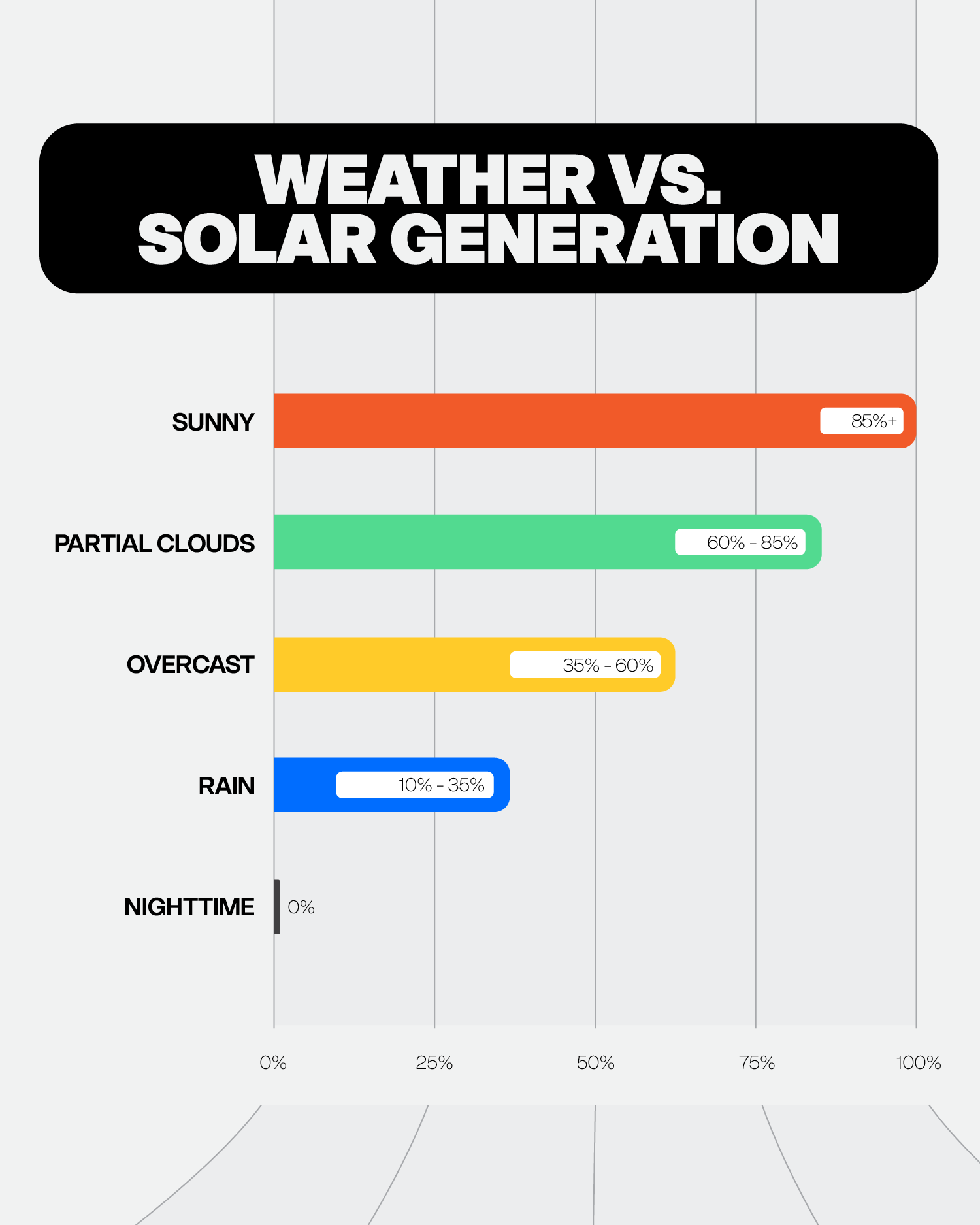
Because we install solar panels across Newcastle & Maitland, we can access real-time data for solar systems across the Hunter region to analyse our cloudy vs. sunny performance. This data will vary day-to-day, but is provided to give you an indication on different weather snapshots.
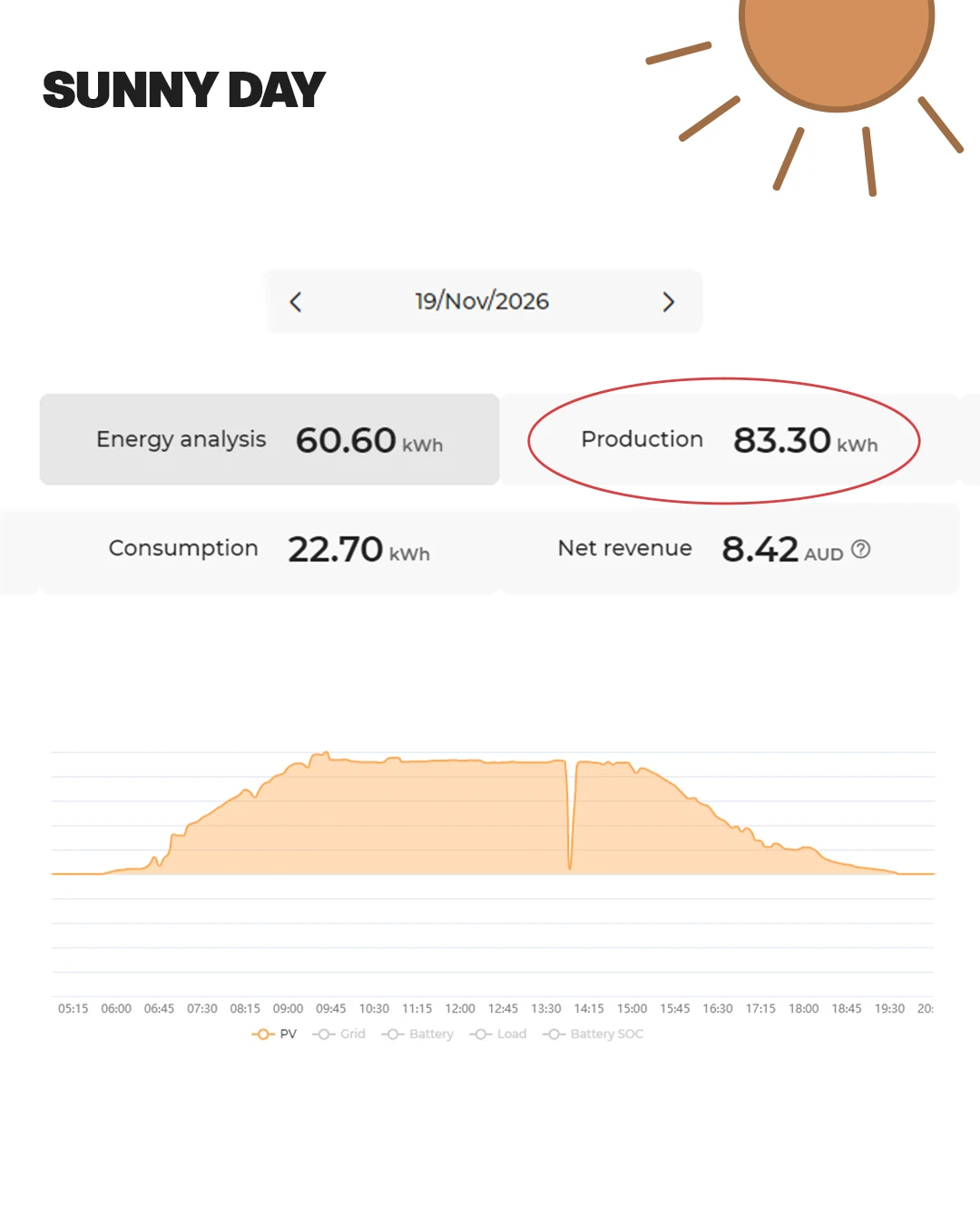
On the sunny day, this system reached around 10-11kW peak solar power output and yielded around 83kWh in production
for the day. This particular day wasn’t too hot but had good sun exposure with very minimal to no cloud coverage.
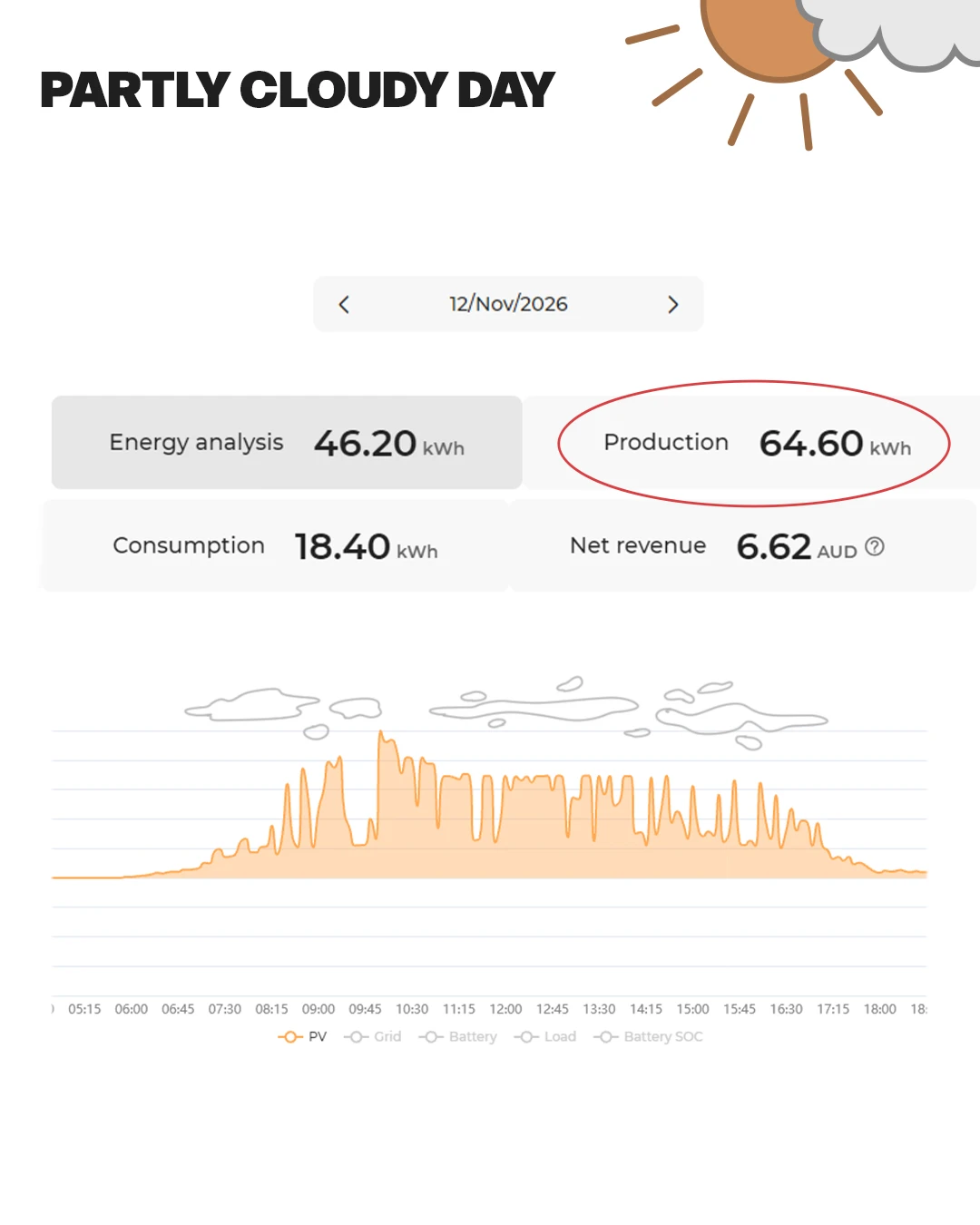
The same system on a partly cloudy day yielded around 65kWh - a reduction of 22.5%, however, still harnessed a good amount of solar to help offset their energy costs.
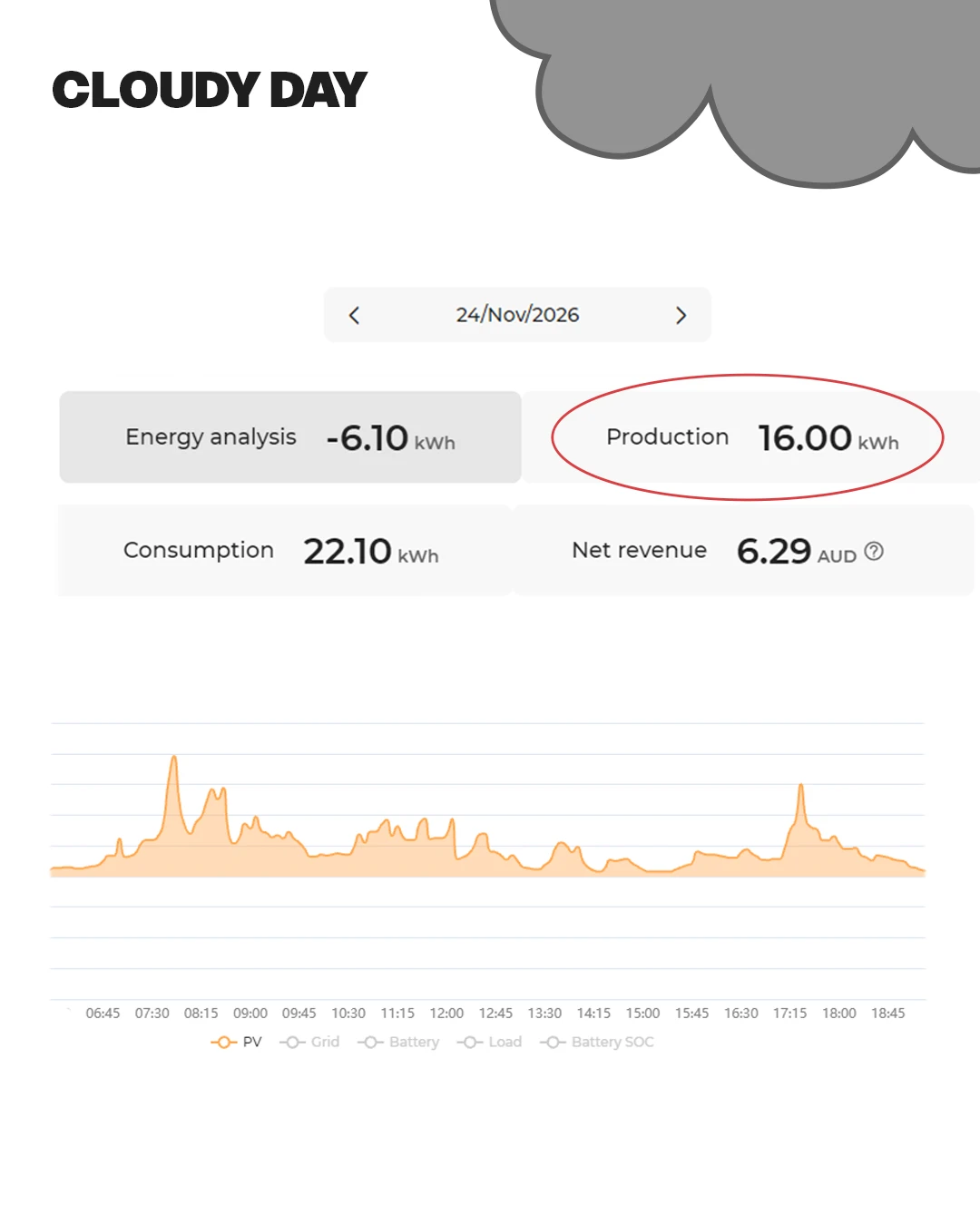
And lastly, a fully overcast day with a little rain (24 November) yielded 16kWh, which is 80.8% less than our sunny day.
The system summary:
This battery is also controlled by Amber SmartShift, so it can charge and discharge differently to a system on a standard retailer plan.
|
13.6kW Solar (31 x 440 Trina Panels) |
25kWh Sungrow SBH Battery Storage |
10kW Sungrow SH10RS Solar Inverter |
Emergency Backup (Full home backup) |
Below is the weather data from the days we have singled out for the comparison. Below the table is the raw data for Newcastle, NSW's November weather.
| Weather |
Daily Energy Production (kWh) | Minimum temp (°C) |
Maximum temp (°C) |
9am Temp (°C) |
Cloud Coverage (oktas) |
3pm Temp (°C) |
| Sunny |
83.3 |
18.5 |
24 |
21 |
- |
21.9 |
| Partly |
64.6 | 18.7 |
21.4 | 20.7 |
5 |
20.7 |
| Cloudy |
16 |
19.4 | 20.9 |
20.4 |
8 |
18.9 |
*Figures are based on 8 weather readings per day (every 3 hours) from rewindweather.com, covering 1 Jan – 24 Nov 2026. A day is classed as Sunny, Partly Cloudy or Overcast when at least 5 of its 8 readings show that condition. Days without a clear majority are assigned to whichever type their average cloud cover is closest to. Download data here.
Whilst sunny weather is always better for solar, there’s a massive difference between partly cloudy day and overcast with no breaks. Let’s compare a snapshot of each:
| |
Sunny Day |
Partly Cloudy |
Overcast |
| Daily Yield (kWh) |
83.30kWh |
64.60kWh |
16kWh |
| Peak Production (kW) |
10.690kW |
14.313kW |
5.8kW |
| Difference % Sunny Day |
- |
-22.5% |
-80.8% |
The overcast day figures will be a little higher than a standard overcast day as there was still small amounts of sunlight coming through,
helping boost the daily yield figure. This system peaked at 5.8kW, most likely when the sun came out for a small period. Without these
peaks, it's possible the daily average power
output
would have been 1.2kW.
The partly cloudy day's 14.3kW peak is higher than both the 13.64kW array and the 10kW inverter, which looks odd but is normal. Sunlight scattering off the edge of nearby clouds can briefly lift light levels above a clear sky (the cloud edge effect covered below), so panels can produce more than their rating for a short time. This inverter accepts up to 20,000Wp from the panels but is rated for 10kW on the AC side, so solar power above that limit can go into the battery or be held back, rather than reaching the home or grid. By comparison, the sunny day peaked at 10.7kW.
Tip: When looking at your solar generation graph, the smoother the chart, means the more consistent the weather was – in this case the sun barely had any interruptions. The spikier it is, the more fluctuations there were throughout the day with cloud coverage.
Even though it feels like solar is some sort of magic, solar PV doesn’t run on heat. Instead, panels generate power from light. PV or photovoltaics is when a current is generated from light.
Panels are not only designed for harnessing direct sunlight, but they’re also made for the days where sunlight is scattered by clouds, haze, and particles in the air. Even though the sun is hidden and can be severely diffused by cloud cover, there’s still enough light to generate power.
Studies have found that partly cloudy skies can deliver more solar irradiance than a clear sky. Known as the cloud edge effect, the light scatters off the edge of nearby clouds near the sun’s direct path, temporarily raising the light levels reaching the panels.

Image courtesy of Ian MacKay
Like anywhere else in NSW, Newcastle and the Hunter region is exposed to some amazing sunlight, making solar a perfect choice for homes and businesses. However, cloud is a part of life in the region, with 112 overcast days and 77 partly cloudy days occurring in Newcastle NSW.* (as of 24 November 2026).
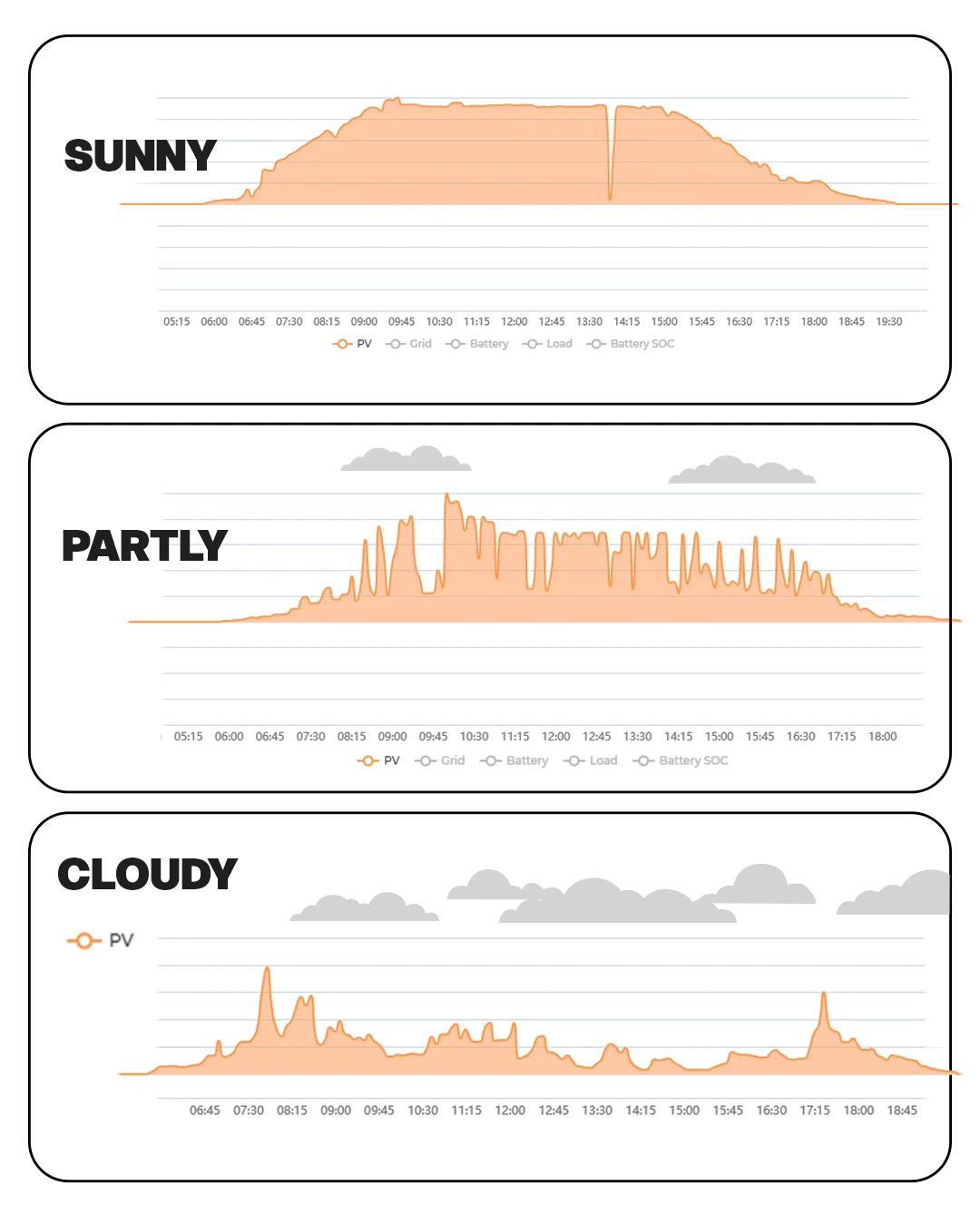
On 24 November, the Newcastle based system yielded just 16kWh, compared with 83.3kWh on the sunny day. That means a heavy overcast day with a little rain can cut your system's output by a little over 80%.
We unfortunately can’t alter the weather; however, we can implement ways to change how we maximise our solar generation.
Oversizing your solar can help generate more. As a part of the 33% rule, solar systems can be more than the inverter capacity which enables it to produce more in periods of lower generation like morning, afternoon, and cloudy weather. The system we’ve been referring to has been sized up to 13.64kW, even though the inverter is only rated for 10kW.*
Adding battery storage will enable you to access stored excess solar energy, which will help act as a buffer during periods of low sunlight exposure. Oversized solar systems can also help charge the battery faster too.
And lastly, changing when we use our energy can help match the dynamic nature of passing clouds. Whilst no one really has time to watch the clouds, we can still use appliances over the course of the day to help offset it, instead of using all your high-powered appliances at once which will be supplemented with the grid.
*This means that can only use a maximum of 10kW at its peak but produces more on either side of the middle of the day due to the higher wattage and various roof faces. 13.64kW of panels on an inverter rated for 10kW on the AC side, which accepts up to 20,000Wp from the panels.
How much a cloud cuts your performance is determined by its thickness or density. Depending on how much of the sky it covers and
whether the sun can get through, there will be various reductions depending on the cloud
type.
Cloud Type |
What it looks like |
Estimated Output Loss |
| Cirrus (high) |
Thin white wisps made of ice crystals |
About 5% to 20% |
| Altocumulus (middle) |
Patchy layer of rippled white cloud |
About 20% to 50%, shifting as patches pass the sun |
| Cumulus (low) |
Puffy individual cells with flat bases |
About 40% to 60% under heavier cover, with brief boosts at cloud edges |
| Stratus (low) |
Grey layer with an even base |
About 50% to 80%, steady through the day |
| Nimbostratus (middle) |
Thick, dark sheet that brings steady rain |
About 75% to 90% |
| Cumulonimbus (storm) |
Very tall towers, often with an anvil top |
About 80% to 95%, but storms pass quickly |
Depending on the cloud coverage, your system can remain pretty good in its solar output, providing your homes and appliances with renewable
energy.
Not every system will act the same as everyone will have different components, orientations, consumption habits, and energy goals, but
most cloudy days throughout NSW will still provide enough energy to help minimise your grid usage.
We are Elite Power Group, expert solar installers based in NSW, Australia, helping business and homeowners get all the knowledge they need to find the best system for their needs. We want to provide as much reliable and expert information as possible to help you make the most informed decisions.
Liked this article? Make sure to rate it and leave a comment below!
Solar is always marketed as a free energy generator on sunny days when the sun is glowing, but what happens during cloudy and wet weather, and how do solar panels perform?
Read moreFind out how the NSW Emergency Backstop Mechanism rollout affects your solar system, & what you need to do to stay compliant in the Ausgrid network.
Read moreWhat the Clean Energy Council's January to June 2026 report found on rooftop solar, home batteries, forecasts and complaints, and how to read the figures.
Read moreRenewable News Articles
Sign up for new article updates - we don't spam.
We've invested in becoming fully-licensed and qualified installers to ensure homes and businesses get
the best solar, battery, and electrical systems available.
Certified solar system installers near you.
Get SAA-Approved Battery Installations.
Fully-licensed electricians Near You.
Convenient EV charging stations for properties.
Leave a Comment