Newcastle's Leading Residential & Commercial Solar Installers

Newcastle's Leading Residential & Commercial Solar Installers
Posted 27 Aug
Want the latest in energy, solar, and savings?Subscribe to our newsletter – we don’t spam!

With a total of 2.6GW of rooftop solar installed over 2025, more and more Australians are looking into getting the right sized solar system for their home and usage throughout 2026... but what size solar system do I need?
Quick answer: As a general guide, 3-4kW suits a small household with light daytime usage, 6.6kW-10kW covers most family homes, and 13.3kW or larger is worth considering if you've got a pool, EV, or ducted air conditioning. The right size for you comes down to your daily usage and roof space, both of which we break down below.
A standard residential solar panel today measures roughly 1.7 to 1.8 metres (170-180cm) long by about 1.1 metres (110cm) wide, and weighs
somewhere between 21 and 24kg depending on the model. Panel size hasn't changed much over the last few years, what has changed is how much
power each panel produces in that same footprint, a 440W panel and a 470W panel are close to identical in size, the difference is
entirely in the cell technology inside.
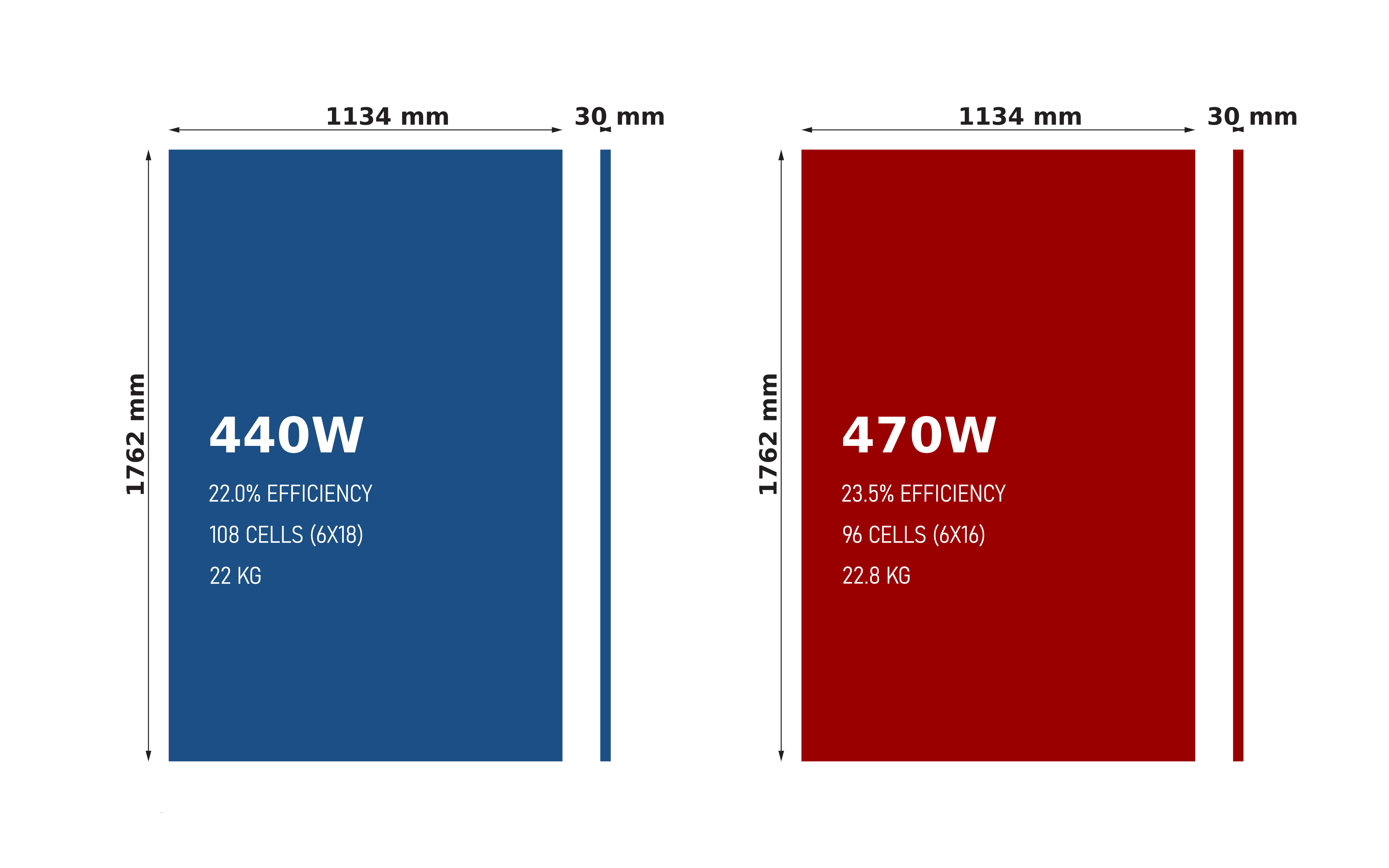
The blue panel refers to JA Solar's 440W panel (1762x1134mm), and the red one TW solar's 470W panel (1762x1134mm). For exact figures on the panels we install, Trina, JA Solar and TW Solar each publish their specific dimensions, generally within a centimetre or two of the range above.
When looking into the ideal solar system size for your home, there are quite a few elements to consider in finding the right sized system, from both a power and physical installation perspective.
Being one of the more-popular choices for homes, small-to-medium households can take advantage of offsetting daily energy consumption with a 6.6kW solar system.
(14-15 Panels)
A 10kW solar system is designed and optimal for larger households with increased general consumption. This helps reduce
daytime usage and increases sustainability.
(21-23 Panels)
A 13.2kW solar system offers that much more powerful supply of renewable power throughout the day, enabling high-consuming
appliances like air-conditioners.
(28-30 Panels)
The average residential solar system size in NSW is currently around 11.6kW, though most homes still install somewhere between 6.6kW and 10kW. So should you just get an 11.6kW system because that's the average? Not necessarily, that average includes plenty of larger installs skewing the number up, and every household's actual usage, budget, and goals will land them somewhere different.
The average has been climbing for a few reasons: higher electricity bills making bigger systems pay themselves off faster, more households running EVs and ducted air conditioning, and the growing popularity of pairing solar with a battery, which makes oversizing your panels worth it even if you're not using all of it in real time.
How many panels is a 10kW solar system? If you opted for a 10kW solar system installation with 470W solar panels, you’d be looking at around 22 solar panels for your roof. (10,000W ÷ 470W = 21.3 Panels).
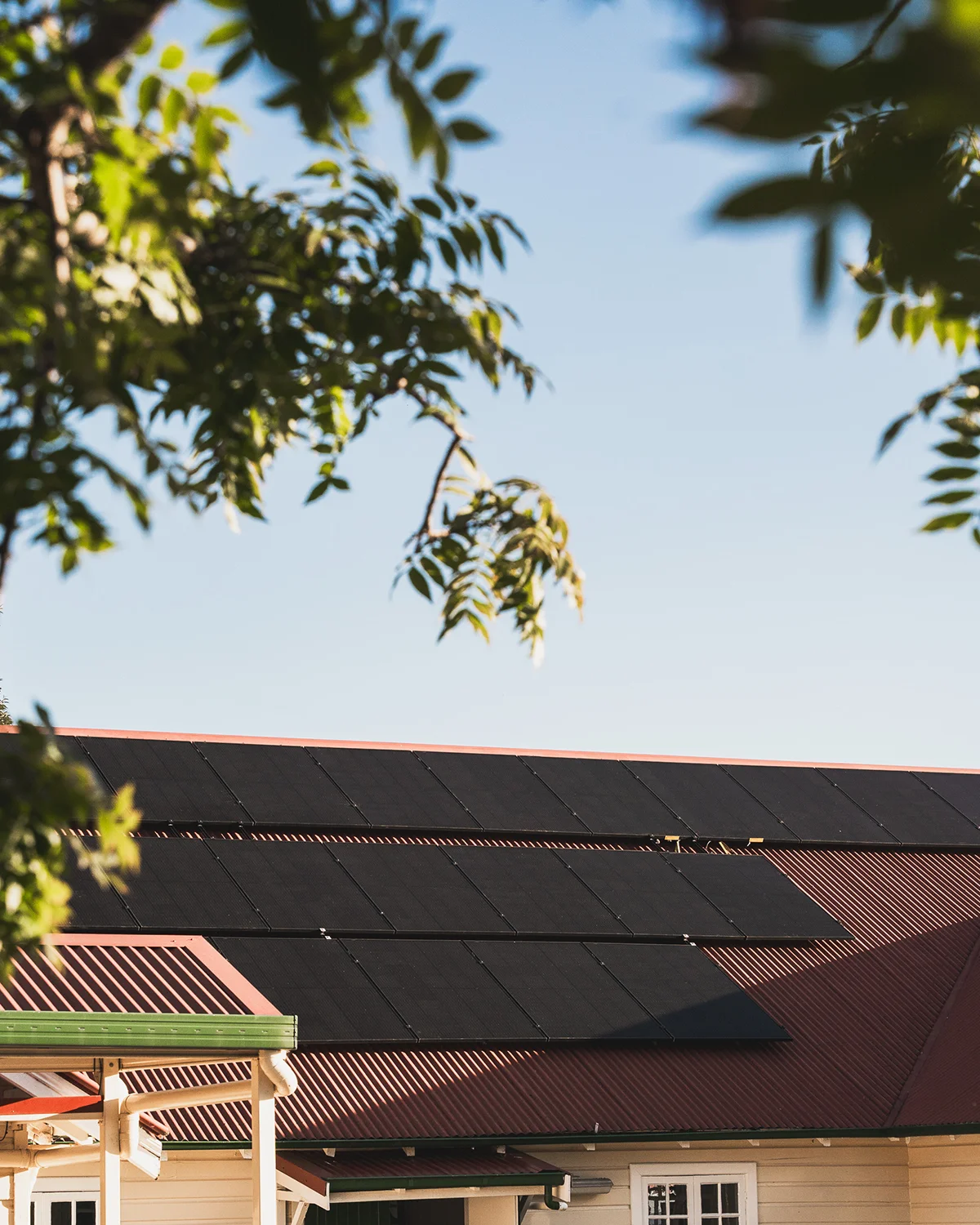
SMALL HOME SOLAR SYSTEM SIZE
Best suited to 1-2 person households using roughly 8-12kWh a day, typically with modest daytime usage and no major electric appliances. A
3-4kW to 6.6kW system usually covers this comfortably. (8-14 Panels)
MEDIUM HOME SOLAR SYSTEM SIZE
The right fit for most 3-4 person households using around 14-20kWh a day. A 6.6kW to 10kW system gives enough daytime generation to offset
that usage without excessive export. (14-22 Panels)
LARGE HOME SOLAR SYSTEM SIZE
Suited to 5+ person households, or any household running an EV charger, ducted air conditioning, or electric hot water, typically using
20kWh+ a day. A 13kW system (or larger) makes better use of that higher draw. (28-30 Panels)
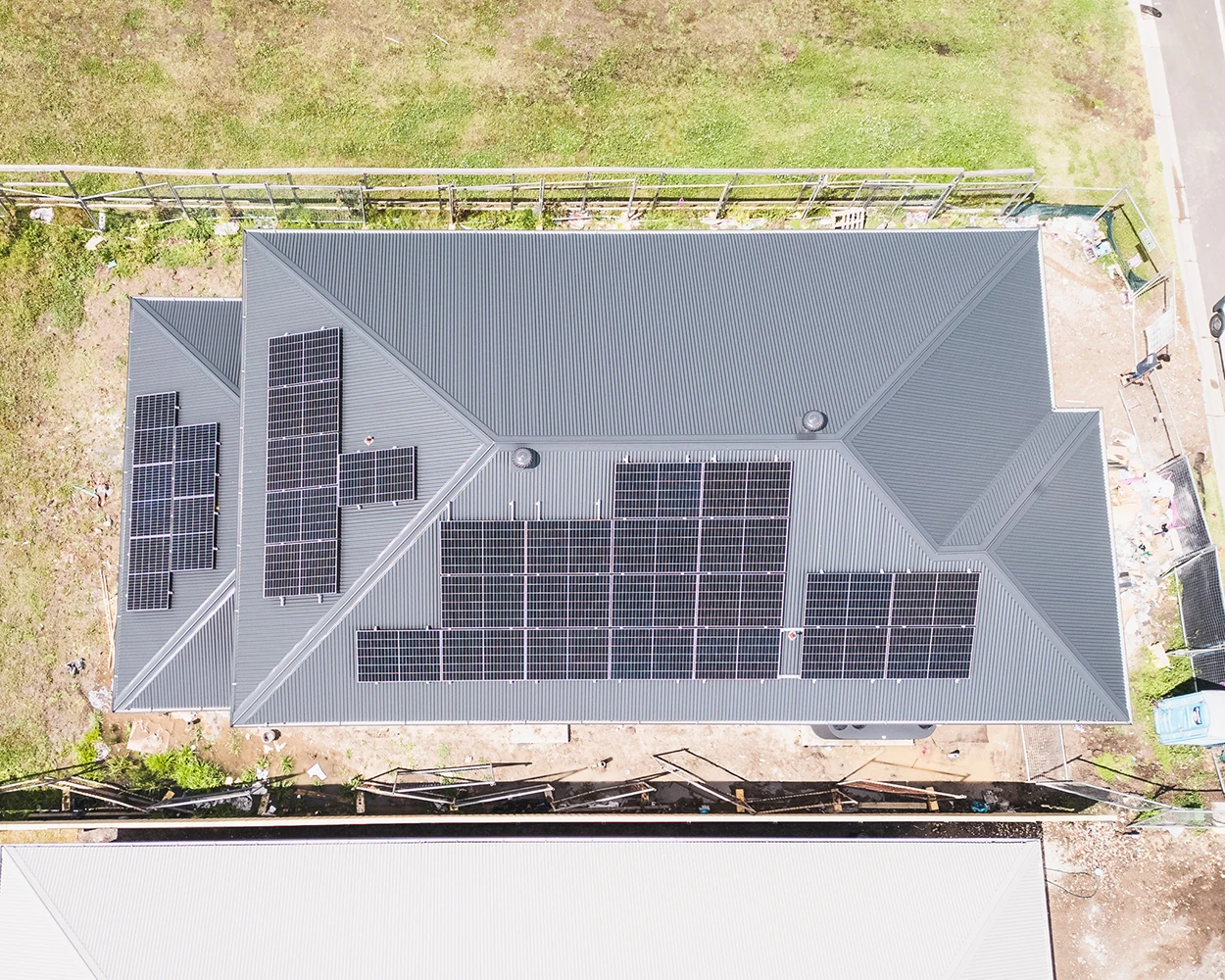
Broadly, 6.6kW suits smaller households with modest daytime consumption, someone who's out at work most of the day and using power mainly in
the evenings won't get much extra value from going bigger. 10kW makes more sense once you've got EV charging, ducted air conditioning, or a
household that's home and drawing power throughout the day, since there's more solar production available to offset that higher daytime
usage rather than exporting it back to the grid for a lower feed-in rate.
| 6.6KW |
10KW |
|
| Best for |
2-3 person households | 4-6 person households / larger consumption |
| Daily output (approx) | 14-19 kWh |
21-33 kWh |
| Panels needed (470W) | 14 |
22 |
| Typical cost |
$6,000 - $9,600 | $9,750 - $13,600 |
When installing solar anywhere in NSW, it's worth considering the requirements set by your local energy provider (DNSP), who are responsible for maintaining the grid and its compliance.
Whilst DNSP requirements vary, each provider will have their own guidelines for what needs approval. For example, Ausgrid states that households can get up to 10kW per-phase (based on the inverter size).
This means that a single-phase house can install up to 10kW of solar, and a three-phase home can install up to 30kW as it has three phases.
However, there's a little trick installers like to use - where a solar system can be oversized by up to 33% as the 10kW per phase capacity per phase refers to the inverter rather than the amount of panels on your roof.
For example, a 10kW inverter can be paired with 13.3kW of solar capacity and a 5kW inverter can pair with a 6.6kW solar system to suit the requirements.
The 33% rule is why we rarely see the same solar and inverter size installed, as the additional production helps produce more solar energy in the mornings & evenings.
Choosing the right solar system size is essential to ensuring your system is well-balanced and provides you with maximum savings and
benefits within your pricing budget.
For smaller, 2-3 person households, a 6.6kW solar system is optimal, providing from $1,300-$1,600 in savings, which costs around $6,000-$9,600*.
For slightly larger medium-sized homes, an 8kW solar system is recommended for savings around $1,600-$1,900 annually, and costs around $8,250-$12,000*.
Large households with 4-5 people could take advantage of a 10kW solar system which costs around $9,750-$13,600* and saves approximately $1,900-$2,400 per year.
For even more solar capacity, a 13.3kW system typically costs around $12,400–$16,600*, providing around $2,400-$2,800 of energy bill savings per year.
*Base supply & installation pricing is only indicative as the time of this article and are subject to a site inspection.
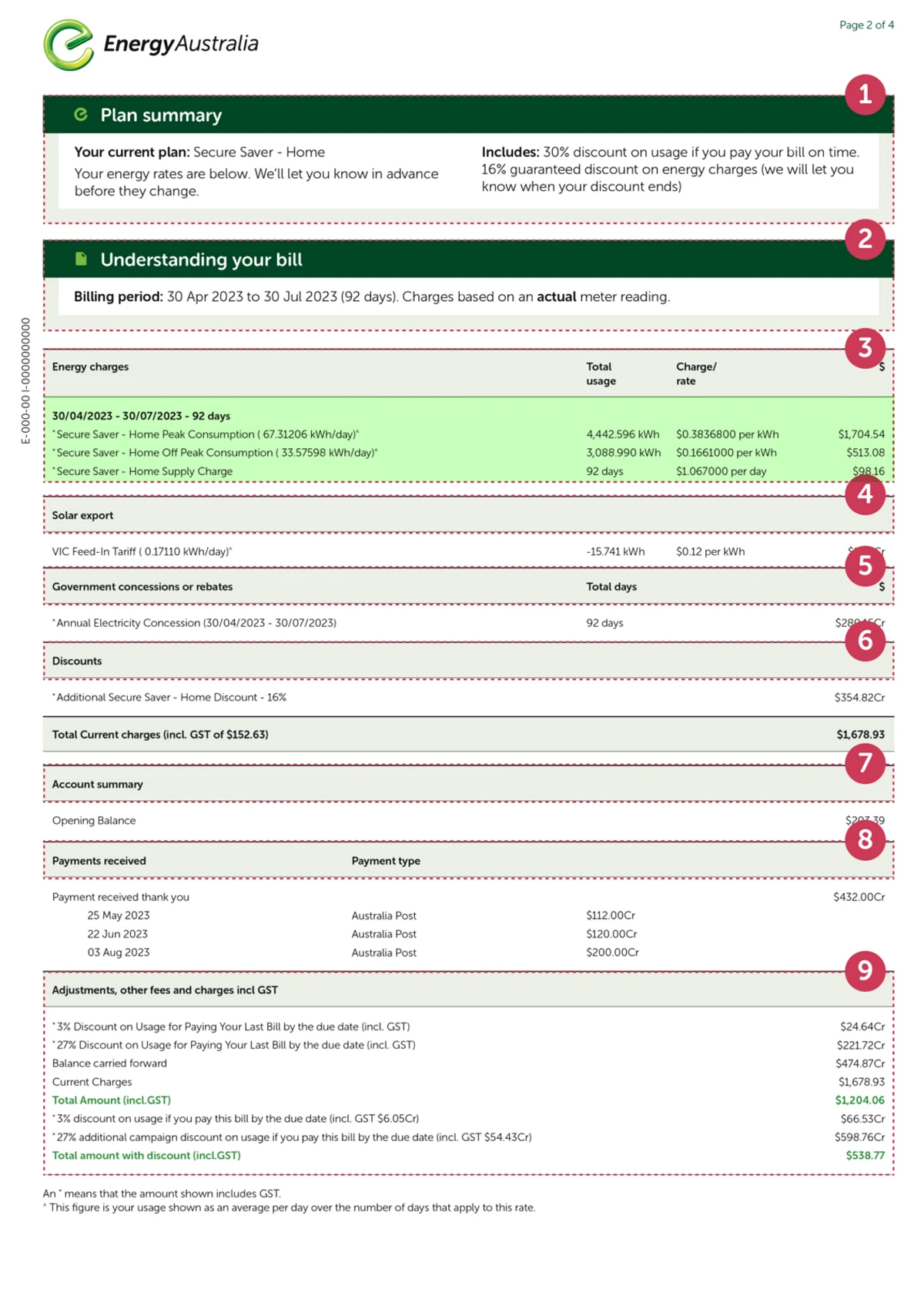
Your electricity bill is genuinely the best starting point for sizing a system properly. Analysing your most recent bill tells you your actual average daily usage and roughly when you're using most of it, both matter more than any rule of thumb. If you'd rather skip the maths, the calculator further up this page does it for you using a few household details, the bill just gives you the real numbers behind those estimates.
Usage shifts with the seasons too, so it's worth checking a few bills across the year rather than just your most recent one. Summer and winter production and consumption move in opposite directions to what you'd expect, more sun in summer, but often more usage too once the air conditioner's running daily.
If your usage is highest in summer because the air conditioner's on constantly, or you're planning to get an EV, it's worth sizing up rather than aiming for the bare minimum, a system that only just covers today's usage gets eaten up fast once a new appliance enters the picture.
The goal isn't to match some average household, it's to land on a size that actually fits how yours uses electricity.
Picking a panel comes down to a few practical things: efficiency (how much power you get per square metre of roof), warranty length and
what's actually covered, and the manufacturer's track record for still being around in 10 or 30 years if you ever need to make a claim.
Higher wattage panels also mean fewer panels for the same output, worth factoring in if your roof space is limited. Below are three brands
we install regularly and trust for Australian conditions.
Trina Solar has built a strong reputation across Australia for reliable, high-performing solar solutions. Their Vertex series caters to both homes and commercial projects, offering efficiency, durability, and design appeal.
With solid local support and long-term warranties, Trina remains one of the most trusted solar manufacturers globally.
We love and recommend Trina's Vertex S+ series modules.
As one of our most installed solar brands, JA Solar is known for dependable performance and strong value.
The company's focus on efficiency and cost-effectiveness has made them a popular choice among installers and homeowners seeking reliability without premium pricing.
Our most installed JA solar modules: The JA Solar DeepBlue 4.0 Series.
Being one of the world's largest vertically integrated solar companies, TW Solar produces every part of their modules in-house.
Their panels are known for consistent output and robust build quality, making them well-suited to Australia's diverse climates. TW's growing market presence highlights their balance of quality, innovation, and long-term performance.
Our TW top pick: TW TNC 2.0 Module Series.
As mentioned, the average NSW home uses around 17.2kWh of electricity a day, though usage swings well outside that for bigger households or homes running an EV or ducted air conditioning, but that number alone doesn't tell you when that power's actually being used, and timing matters just as much as the total.
Even a solar system producing more than you use across the day can still leave you buying expensive grid power at night. If most of your usage happens after the sun's gone down, a bigger solar-only system won't fix that on its own, you'll still be exporting cheap and buying back expensive.
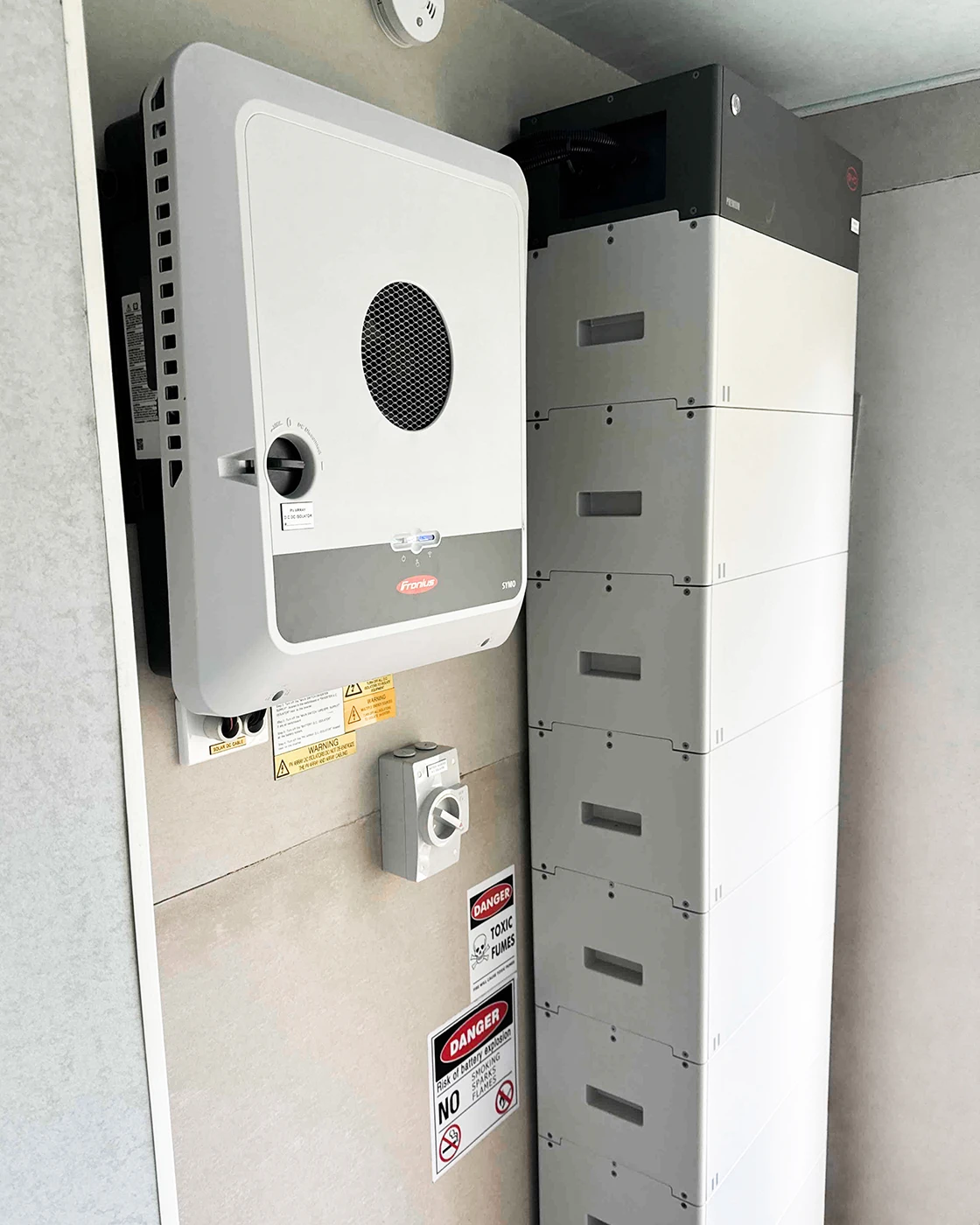
That's the gap a battery closes. If your system's sized right, the extra solar that would otherwise be exported at a low feed-in rate goes into the battery instead, ready to use once the sun's down rather than buying it back from the grid at peak rates. Your bill is the easiest way to see which camp you're in. Once you know how your usage splits across off-peak, shoulder and peak periods , it's a lot easier to size the right solar system, and decide whether a battery is worth adding alongside it.
Getting your solar system size right comes down to three things: your actual daily usage (check your bill or use the calculator above), your available roof space, and whether a battery is part of your plans now or later. A 6.6kW system suits most smaller households, 10kW is the sweet spot for larger families or daytime-heavy usage, and 13.3kW+ is worth considering if you're running an EV, ducted air conditioning, or planning to add a battery down the track.
From there, choosing a reputable panel brand and a fully-licensed, SAA-approved installer matters as much as getting the size right, an oversized system installed poorly will still underperform.
Explore whether rooftop or ground mounted solar systems are better for homes, farms, and remote properties needing solar PV power in Australia.
Read moreThe journey of bidirectional charging in Australia has hit a milestone with the recent approval of the new standard for vehicle-to-grid (V2G) charging for 2025.
Read moreFor cabins, homes, and sheds with limited or no access to grid energy, getting an off grid solar and battery storage system may be worth it in NSW in 2025.
Read moreEveryone has seen a solar installation a normal roof like tin or tiled roofs, but have you ever seen a solar installation a roof made of Brass? Well we did one...
Read moreWith the release of the new Clean Energy Council (CEC) H1 2024 report on solar and battery storage, it gives an idea of the upward path of Australia’s renewable energy adoption.
Read moreAmber & ARENA have started trials for Vehicle-to-grid technology in NSW, Australia to help develop standards and framework in V2G and Bidirectional charging.
Read moreCompare Tesla Powerwall 2 vs Powerwall 3 in Australia. See differences in capacity, power output, dimensions, specifications, pricing & solar compatibility.
Read moreExplore solar battery fire risks, hazards, and statistics, and if solar batteries are safe to install for homes in NSW, Australia. (Spoiler alert.. they are!)
Read moreThough bidirectional charging isn't available, vehicle-to-grid is already turning heads in Australia with its potential to change energy consumption and distribution.
Read moreExplore how Australia's energy is evolving with t like Microgrids, DER's, Virtual Power Plants, & Demand Response, for solar and battery systems.
Read moreLearn alternating and direct current, and the differences between AC vs. DC with real-life examples and diagrams of power flow and voltage in Australia.
Read moreEverything NSW businesses need to know about commercial battery storage - costs, benefits, peak shaving, backup power, and how to choose a system.
Read moreIn the new 2024 CEC report, they found that renewable contribution in the overall supply of energy in Australia, produced 40% of Australia’s total electrical supply.
Read moreSo you've invested in solar to reduce your electricity bills, but since then your bills are still high? Explore why your energy bills are still high even after solar.
Read moreLearn electricity tariffs like single-rate, controlled loads, and time-of-use tariffs where on and off peak pricing occurs through retailers like energy australia.
Read moreExplore the differences between single phase vs. three phase power, and how 1 phase and 3 phase electricity works with real-life examples in Australia.
Read moreIf your solar panels are dirty, explore easy ways to DIY clean your solar panels, or when to get your system cleaned by a professional solar cleaner in Australia.
Read moreBatteries store energy as chemical potential energy, released as electrical current once connected to a circuit. Learn how batteries store & release energy.
Read moreNow is the best time to invest in solar panels.. here are 4 reasons why Australians should invest in solar energy before it's time runs out for 2024.
Read moreExplore the National Electricity Market (the NEM), and how it interconnected 5 states with electricity distribution to balance demand and supply in Australia.
Read moreDiscover how agrivoltaics can benefit farms by combining agriculture and solar energy to increase sustainability and agricultural production in NSW.
Read moreThe energy required to heat hot water is quite high and for most Australian households. Here are some strategies on how to save on your hot water heating bill.
Read moreWhat's the best Solar EV Charger? Zappi or the Wattpilot? We have put together a side-by-side comparison, including the pro’s and con’s for both EV chargers.
Read moreWith booming solar adoption, Newcastle is quickly becoming a sustainable region with homes and businesses adoption the technology. What's happening?
Read moreDifferences between bidirectional Vehicle-to-Grid (V2G), Vehicle-to-Home (V2H), Vehicle-to-Load (V2L), and compatible chargers and EVs in Australia.
Read moreOur team attended the Electric Vehicle open day in Lake Macquarie hosted by Lake Macquarie City Council, and what a day! From all the fun events, to the informative aspects, everyone definitely got something out of the day.
Read moreRenewable News Articles
Sign up for new article updates - we don't spam.
We've invested in becoming fully-licenced and qualified installers to ensure Newcastle homes and businesses
get the best solar, battery, and electrical systems available. We want to assist Newcastle's renewable energy revolution with quality
installations for maximum customer satisfaction.
Certified solar system installers near you.
Get CEC-Approved Battery Installations.
Fully-licenced electricians in Newcastle.
Convenient EV charging stations for properties.
Leave a Comment