Hunter Valley's Leading Residential & Commercial Solar Installers

Hunter Valley's Leading Residential & Commercial Solar Installers
Posted 2 May
Want the latest in energy, solar, and savings?Subscribe to our newsletter – we don’t spam!
For businesses with solar, the maths is straightforward during the day - solar covers usage, bills drop. The problem is what happens at night, on cloudy days, and during the peak-rate windows when grid electricity costs the most. Commercial battery energy storage systems (BESS) fix that gap by storing surplus solar generation and releasing it when it's most valuable.
Quick answer: Yes, for most Australian businesses on a demand tariff or time-of-use plan with rooftop solar, commercial battery storage is worth it. The return depends on two things: your tariff structure and your load profile. Businesses with demand charges (which can make up 30–50% of a commercial electricity bill) typically see the strongest case, a battery that flattens demand spikes saves money regardless of solar.
But commercial battery storage is worth more than just extended solar hours. For businesses on demand tariffs - which covers most commercial and industrial electricity customers in Australia - a correctly sized battery system can shave demand charges that are calculated on a single 15-minute peak and carry across an entire billing period. That's often where the biggest financial return sits, independent of solar entirely.
Commercial battery energy storage systems (BESS) store electricity either from rooftop solar, the grid at off-peak rates, or both, and release it on demand. Unlike residential batteries that are sized for a single home's evening usage, commercial systems are designed around a business's operational profile: when the business runs, how much it draws, what its peak demand looks like, and what its tariff structure rewards.
The core operating logic is the same as residential but with higher stakes. A commercial battery monitors real-time grid consumption and switches to discharge when consumption approaches a threshold - typically a demand tariff peak period, or simply when grid rates are highest. It recharges during periods when electricity is cheapest: overnight off-peak, during Solar Sharer free windows, or directly from rooftop solar throughout the day.
For businesses with significant rooftop solar, the battery acts as an energy buffer. Solar generates throughout the day; the business consumes what it needs; surplus goes into the battery rather than being exported for a low feed-in tariff. At night, or when solar generation drops, the battery covers demand from stored energy instead of grid power.
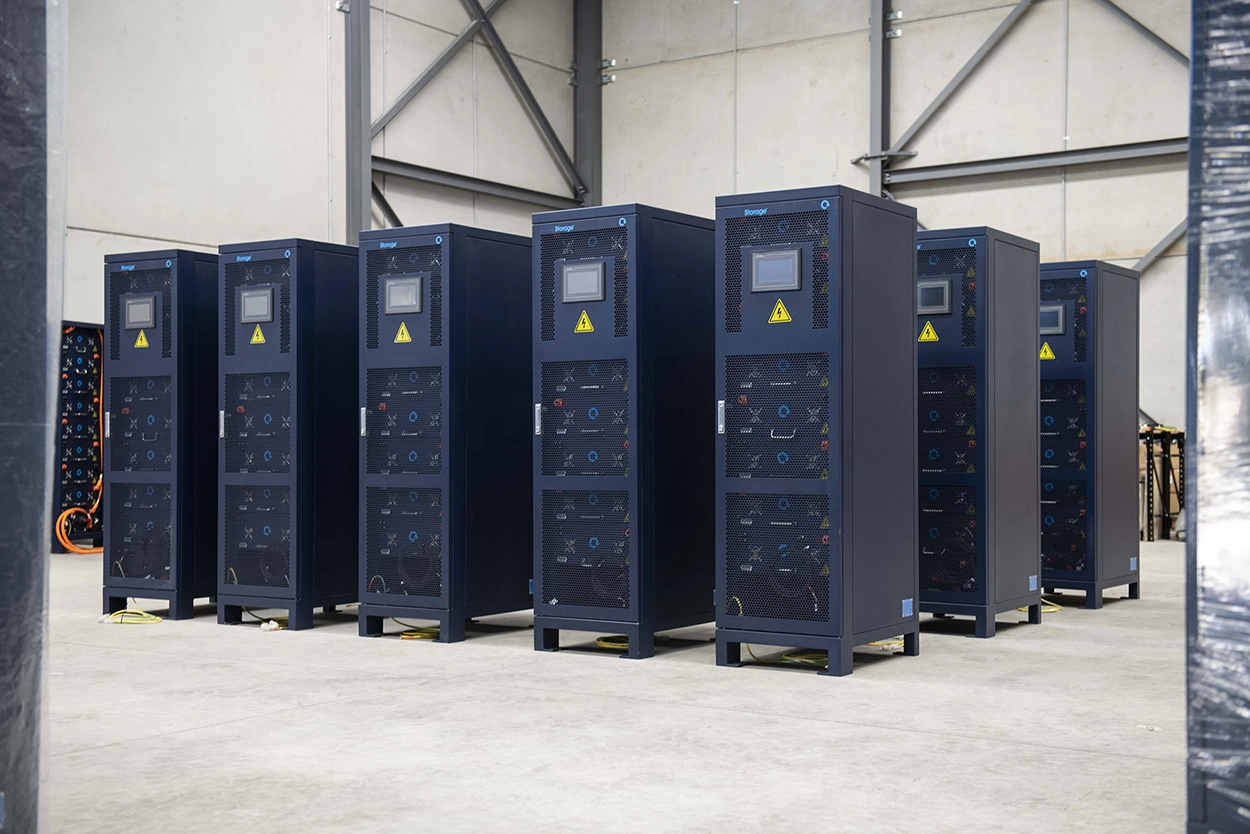
Commercial battery storage systems range from scalable modular setups suited to small businesses through to large custom enclosures for industrial operations. The key metrics for commercial systems are energy capacity (kWh), power output (kW), cycle life, and whether the system is designed for indoor or outdoor installation.
Tesla's utility and large commercial-scale BESS, with integrated liquid cooling, fire suppression and a proven global track record. Suited to large industrial operators, major property developers and projects where the scale and credibility of a utility-grade product is the requirement.
Launched in Australia at Sungrow's Sydney summit in March 2026, the PowerTitan 3.0 houses 1.78 MW and 7.14 MWh per 20-foot container, scalable to 7.2 MW / 28.5 MWh per block. Liquid cooled, AC and DC coupling capable, with an established Australian deployment record including the Templers and Cunderdin projects. The Sungrow large-scale product for commercial and utility-scale projects nationally.
A containerised, utility-grade BESS for applications where modular commercial systems aren't practical. Self-contained and scalable into the multi-hundred kWh and MWh range, the Elementa suits large industrial facilities, shopping centres, agricultural operations, and major commercial projects. The starting point for large-scale conversations.
As mentioned before, by relying on the renewable energy you generate, you can avoid paying demand electricity prices and save on your operational costs.
For businesses where it's crucial to stay operational 24/7, a backup power source may be a great choice to allow you to stay powered during outages.
With a battery, you can participate in programs like Virtual Power Plants that incentivise businesses to earn more with their commercial battery.
For businesses with solar, you may be exporting more than you use. Instead of feeding that excess for cheap, you can store it for later to save more on your bill.
Businesses that value sustainability can stand to benefit from increased renewable energy consumption both through the day and night.
In a world of uncertainty, energy prices are vulnerable to fluctuations. A commercial battery could help further protect you from fluctuations.
The right system for your business depends on your energy consumption profile, your existing solar infrastructure, your site's physical installation constraints, and your capacity requirements now and in the future. As a rough guide:
| Business Type | Recommended Initial Capacity | Recommended Initial Battery |
| Small commercial (cafe, retail, small office) |
20-40kWh | Sungrow SBH, Fronius Reserva, GoodWe ESA |
| Medium commercial (warehouse, light manufacturing, hospitality | 40-100kWh |
Sungrow SBH, Fronius Reserva, GoodWe ESA |
| Large commercial | 100kWh+ | GoodWe ESA, Sungrow SBH, TrinaStorage Elementa, Sungrow PowerTitan |
| Utility/Grid-Scale / Industrial |
- |
Sungrow PowerTitan, Tesla Megapack |
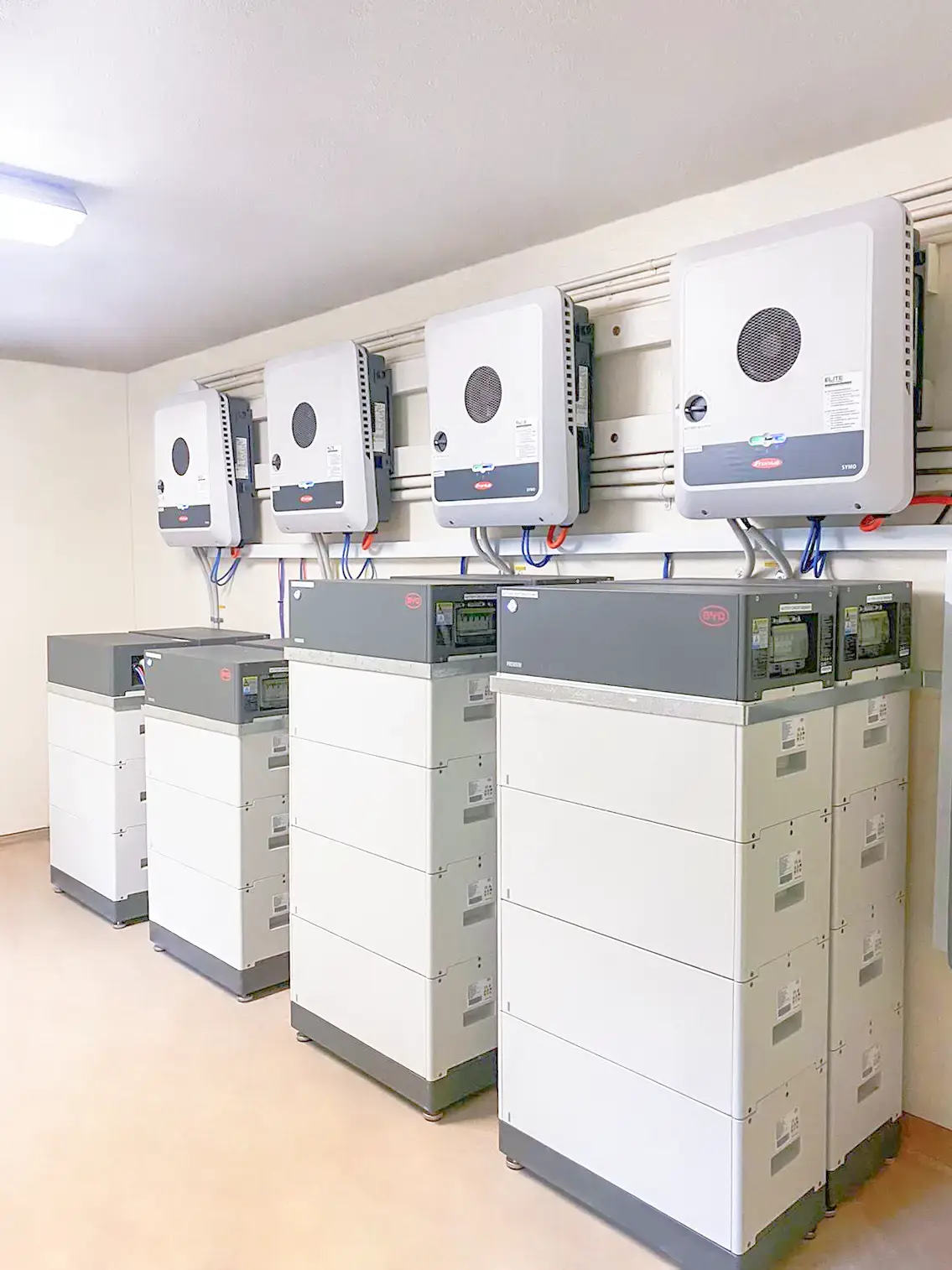
Inverter integration is a significant cost factor, a commercial battery paired with an existing commercial solar inverter costs less than a system that requires a new inverter or hybrid inverter capable of handling both solar and storage simultaneously.
Network connection requirements vary by distributor and system size. Ausgrid, Endeavour Energy and Essential Energy (NSW) each have specific embedded network requirements for commercial BESS that affect design and installation costs.
Battery chemistry affects both upfront cost and long-term economics. LFP systems have higher upfront costs than older NMC or lead-acid alternatives but significantly longer cycle lives and lower maintenance - almost always the right choice for commercial applications on a total cost of ownership basis.
Commercial battery storage payback depends heavily on the business's tariff structure. For businesses on demand tariffs with large demand charge components, payback periods of 4–7 years are achievable. For businesses on flat-rate or simple TOU tariffs without solar, payback periods are typically longer. A detailed energy audit and load profile analysis is the only reliable way to calculate payback for a specific business - generic estimates are rarely accurate.
For NSW commercial battery installations specifically, there are several regulatory and network requirements worth understanding before installation:
Distributor requirements: Ausgrid, Endeavour Energy and Essential Energy each have their own embedded network requirements for commercial BESS. System size thresholds affect the level of network approval required — systems above certain capacities require formal connection applications and may trigger protection equipment upgrades. Your installer should manage this process, but understanding it exists is important for project timelines.
AS/NZS IEC 62619: the Australian standard for battery safety, covering design, testing, and installation requirements. Any commercial BESS installed by a reputable, CEC-accredited installer will be compliant. Systems that aren't — particularly from unknown brands without Australian standards testing — carry both safety risk and insurance implications.
CEC accreditation: the Clean Energy Council's commercial battery installer accreditation is the commercial equivalent of the residential CEC accreditation. For commercial systems in NSW, check that your installer holds commercial BESS accreditation, not just the residential qualification.
Metering: commercial BESS installations in NSW typically require an interval meter upgrade to a smart meter capable of recording 30-minute or 15-minute interval data. This is usually arranged by your electricity retailer or distributor as part of the connection process.
Rising grid electricity prices. Commercial electricity tariffs in NSW have increased consistently. With demand charges and peak rates continuing to rise, the value of stored energy that avoids those rates compounds year on year.
Solar saturation and low feed-in tariffs. Businesses that installed solar 5–8 years ago are now exporting significant volumes of electricity for feed-in tariffs of 3–8c/kWh, while importing peak-rate power at 30–70c/kWh. The case for a battery to capture that export and use it internally is now compelling for many of those businesses.
Sustainability and reporting requirements. Large companies with ASX-listed customers, government contracts, or ESG reporting obligations are under increasing pressure to demonstrate renewable energy use. Commercial battery storage enables a measurable increase in renewable self-consumption that appears directly in Scope 2 emissions reporting.
Federal and state incentive programs. The federal battery rebate program that launched for residential customers in 2025 included commercial provisions. State-level programs in NSW, VIC, and QLD have also provided incentives for commercial energy storage at various points. Check current eligibility with your installer — the landscape changes frequently.
Commercial solar battery storage is a game-changer for businesses, providing properties with reliable and sustainable power, cost savings, and the opportunity to participate actively in the energy market. By maximising the use of solar energy, businesses can reduce their reliance on the grid, lower their operational costs, and contribute to a more sustainable energy future.
As advancements in battery technology and smart grid integration continue to evolve, commercial solar battery storage systems will become even more efficient, cost-effective, and accessible. Businesses of all sizes will have the opportunity to harness the power of the sun and take control of their energy usage, leading to increased energy independence and a greener bottom line. Embracing commercial solar battery storage is not only a smart business decision but also a step towards a more sustainable and resilient future.
Explore the recently changed VPP NSW rebate, & how the Peak Demand Reduction Scheme (PDRS) calculates rewards for joining a Virtual Power Plant.
Read moreAlready have a Powerwall 2? You can now add a Powerwall 3 alongside it. Supported configurations, limitations and how the rebates stack in 2026.
Read moreAlready have solar? Decide whether to add a battery, expand your panels or replace your system, and which delivers the best return in 2026.
Read moreSupply charges, feed-in tariffs, controlled load, peak rates - we explain every line on your NSW electricity bill and show you where you can save more.
Read moreCompare retailer Solar Sharer plans, check eligibility & opt in. Origin, Amber, AGL, EnergyAustralia & more. 3 hours free power daily from 11am–2pm.
Read moreIs solar & battery worth investing in for Australian homes? Explore 2026 costs, payback periods, disadvantages, and how the Solar Sharer offer affects it.
Read moreLearn about the May 1st Federal battery rebate changes in Australia and what they mean for home battery costs, solar savings, and discounts.
Read moreCompare Tesla Powerwall 3, Sungrow SBR & SBH, GoodWe ESA, Fronius Reserva, and BYD Battery-Box to find the best home battery for Australia.
Read moreExplore how Australia’s Q4 2025 solar and battery data highlights a major milestone: majority renewable contribution to daytime electricity demand.
Read moreHow rooftop solar helped NSW avoid blackouts during the 2026 heatwave, reducing grid stress & supporting record electricity demand across Newcastle.
Read moreExplore Elite Power Group's solar and battery installation statistics for 2025, and how we performed over this year of operation in Newcastle and Maitland.
Read moreEnergy capacity (kWh) is how much a battery stores. Power output (kW) is how fast it delivers. Covers nominal vs useable, SoC, DoD and cycles.
Read moreConsidering a cheap solar system? Learn how low-quality, unreliable inverters and panels can lead to costly repairs, full replacements, and safety issues.
Read moreBattery supply chains are tight across Australia, with shipping delays leaving many installers out of stock and customers waiting longer. What's happening?
Read moreLearn how to avoid solar scams in NSW. Spot red flags & dodgy installer tactics and find reputable companies with great warranty & quality installations.
Read moreOver 56,000 solar batteries were sold in Q2, 2025, thanks to the Australian battery subsidy. Explore solar & battery uptake, growth trends, and what's next.
Read moreDiscover how to choose the right solar battery size for your home. Compare 10kWh, 15kWh, and 20kWh options to maximise savings, and solar in NSW.
Read moreVirtual Power Plants explained for Australian homeowners. What a VPP is, how it works, NSW program comparison and whether joining one is worth it.
Read morePower vs Energy in Australia: Difference Between Watts and Watt-Hours, kW vs kWh, with Diagrams, Calculations, and Home Appliance Examples.
Read moreCompare the difference between Sungrow's SBH and SBR battery storage vs. BYD Battery-Box and find what battery is better for homes or businesses in NSW.
Read moreThe NSW Government have announced that the NSW Battery Rebate (PDRS) will be suspended on June 30th, 2025, and will no longer be available.
Read moreExplore Australia's Federal Government solar battery rebate subsidy like eligibility, approved batteries, requirements, and more about the upcoming incentive.
Read moreCompare home insurance policies and find out if solar and battery is covered and how installations affect costs, value, and included coverage in Australia.
Read moreExplore the differences between AC and DC coupled solar battery storage and how it affects your solar system and inverters' configuration in Australia.
Read moreThe differences between Tesla Powerwall 3 vs. Sungrow battery storage (SBH) capacity, warranty, and features, and which one is better in Australia.
Read moreA very strong storm passed through the Hunter, leaving over 100,000 homes without power. Here's how you can protect your home's energy with independence.
Read moreFor cabins, homes, and sheds with limited or no access to grid energy, getting an off grid solar and battery storage system may be worth it in NSW in 2025.
Read moreCompare Tesla Powerwall 2 vs Powerwall 3 in Australia. See differences in capacity, power output, dimensions, specifications, pricing & solar compatibility.
Read moreExplore solar battery fire risks, hazards, and statistics, and if solar batteries are safe to install for homes in NSW, Australia. (Spoiler alert.. they are!)
Read moreExplore how Australia's energy is evolving with t like Microgrids, DER's, Virtual Power Plants, & Demand Response, for solar and battery systems.
Read moreLearn alternating and direct current, and the differences between AC vs. DC with real-life examples and diagrams of power flow and voltage in Australia.
Read moreEverything NSW businesses need to know about commercial battery storage - costs, benefits, peak shaving, backup power, and how to choose a system.
Read moreIn the new 2024 CEC report, they found that renewable contribution in the overall supply of energy in Australia, produced 40% of Australia’s total electrical supply.
Read moreSo you've invested in solar to reduce your electricity bills, but since then your bills are still high? Explore why your energy bills are still high even after solar.
Read moreExplore the differences between single phase vs. three phase power, and how 1 phase and 3 phase electricity works with real-life examples in Australia.
Read moreBatteries store energy as chemical potential energy, released as electrical current once connected to a circuit. Learn how batteries store & release energy.
Read moreRenewable News Articles
Sign up for new article updates - we don't spam.
We've invested in becoming fully-licensed and qualified installers to ensure Newcastle homes and businesses
get the best solar, battery, and electrical systems available. We want to assist Newcastle's renewable energy revolution with quality
installations for maximum customer satisfaction.
Certified solar system installers near you.
Get CEC-Approved Battery Installations.
Fully-licensed electricians in Newcastle.
Convenient EV charging stations for properties.
Leave a Comment